DUBS FOR SYRIA – OUTERNATIONAL CREATORS AGAINST THE WAR

Out on Vaticaen Production  comes united musical effort with 59 versions of Dub For Syria:

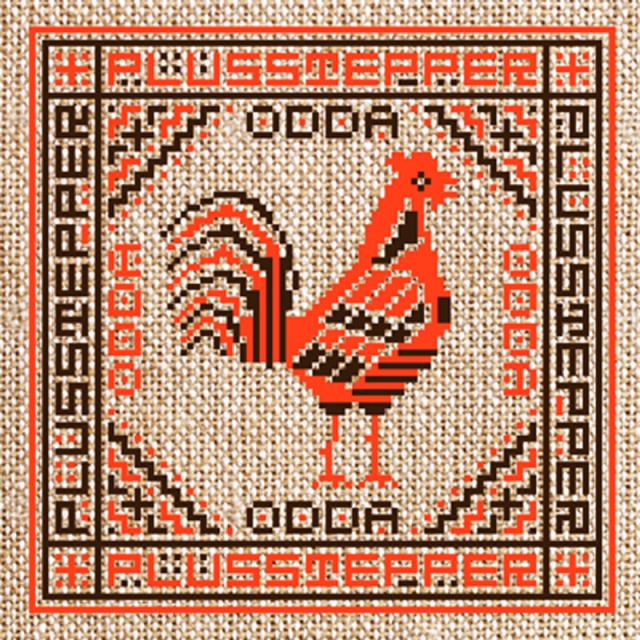
PLUSSTEPPER – ODDA

Out on original underground net label ODG come brand new PlusStepper with a wicked steppa twist:

“The album focuses more on the Roots and Dub with melodica and Balkan brass tunes and differs from the typical electrotniс Stepper sound. It’s a special gift to the New Year of Rooster for all Dub lovers.”

PlusStepper_cover_odda_800.jpg

https://plusstepper.bandcamp.com/album/odda


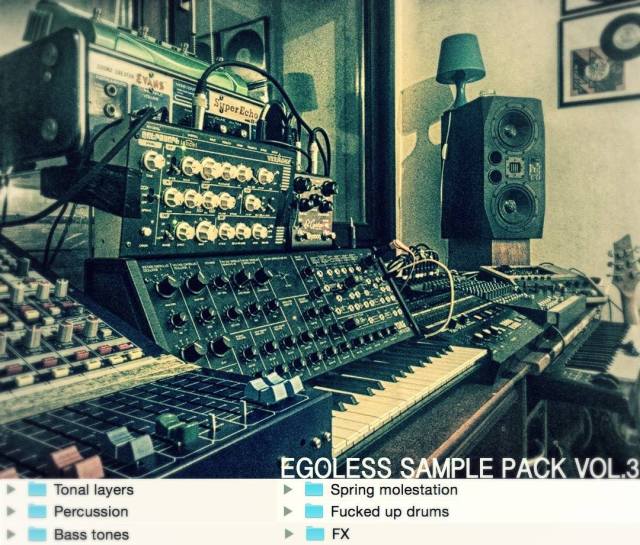
EGOLESS – SAMPLE PACK VOL.3

Extra large sample pack from Egoless. Third in series, so gwan over to Egoless FB and check it!

15167665_10154800361914507_187277121848989121_o

GAPPY RANKS & PROTOJE – WHITE PAPER – MARSHALL NEEKO REMIX

Marshall Neeko with recut from  Iration Steppas & Tena Stelin “Locks” paired with Gappy Ranks & Protoje for a heavy riddim & conscious lyrics.

COSMOS SOUND & IRIE NANARA – NOT LIKE YOU

Lovely original digital ting fresh pon Jump & Prance label outta Madrid. Vocal & dub.


DARK ANGEL – NICE UP DI SESSION

ROBIN UPTON – A BRIEF HISTORY OF PLUTOCRACY

ON GHETTO NYABINGHI

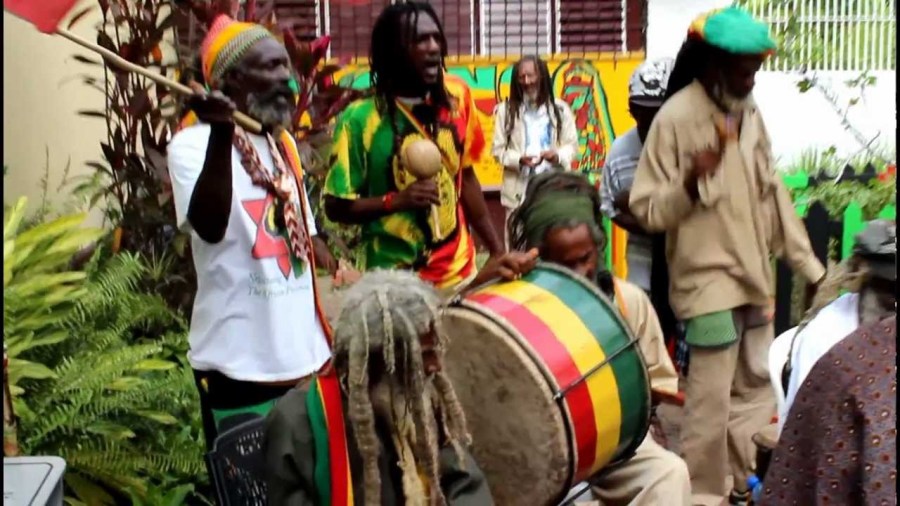
It was in the late 1930s that the Rastafarians began to gain a significant presence in Kingston, and by this time the pre-Rasta Burru peoples (a culture of people in rural Jamaica who were known for their drumming rituals a century ago) had fully settled in the slums.
Unlike the scenario in America, drumming in the Jamaican plantation system was officially tolerated, and the Burru-men, in addition to their role as timekeepers for slave labor, were keepers of African sound. In their search for “anciency” and cultural roots, the Rastafari knelt at the feet of the Burrus, appropriated their looks, style, and musics and, in return, imparted to them a political theology of race. But what was most important to this union of the Burrus and the early Rastafari were the rituals of sound that both communities instituted in the colonial ghettos of Kingston.
Saakana has traced the Burru drumming ritual back to a Ghanaian ceremony that took place around Christmastime. In the 1930s, the ritual of drumming was a customary way of welcoming discharged prisoners back into the folds of the ghetto community.

When the Rastafarians took over the ritual, they modified it, adding their own thematic obsessions to the African songs of insult and praise. From this came the ritual of the nyabinghi, which was said to mean “death to black and white oppressors” and became a term also used to describe the most orthodox members of the Rastafarian creed. In the sacred space of ritual, members of the faith meditated, reasoned with each other, debated Old Testament doctrine, and soundly criticized the exploitative and racist system they were living in. And they beat the drums, chanting down Babylon and conjuring up an alternate space of black community called “Africa.

They did this in the yards of West Kingston, the same spaces that decades later would provide the genesis of the Jamaican sound systems.

Found in Bass History from 

The Sound of Culture: Dread Discourse and Jamaican Sound Systems by LOUIS CHUDE-SOKEI 

(Language, Rhythm, and Sound: Black Popular Cultures into the Twenty-first Century, 1997)

ON DANCEHALL CULTURE IN THE BAKHTINIAN SENSE

Dance events always have a name. Their appeal and consequent power converge around this naming, this rite of celebration, which takes the form of the latest dancehall and/or innercity lingua franca. This is crucial to attracting patrons.
Some of these names include “Ol’ time something come back again,” “Clean up yuh heart an come,” “Girl’s Dem Bashment,”“Bruck out, Bruck out,” “Raw and Rough,” “Fully Loaded,” “Gimme di light,” and “Rasta Jamboree,” among others.

Events are found throughout the calendar year, almost every night, all year round. Dancehall’s liturgical calendar is noteworthy simply because it persists regardless of season or state power and presents a challenge to conceptualizations of popular dancehall culture as “carnivalesque” in the Bakhtinian sense.

The dance is not just an event; it is a system of rules and codes, an institution.
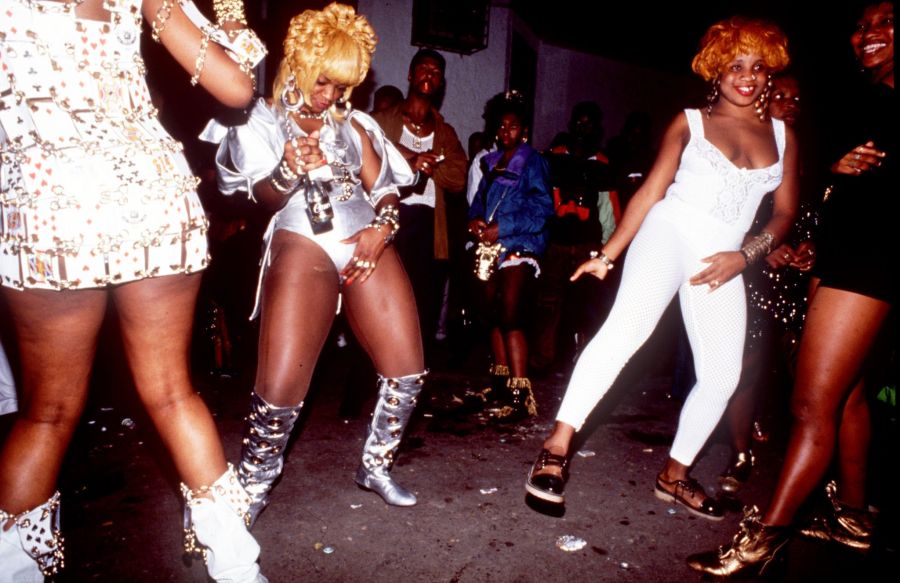
Women adorn themselves according to the dictates of the current dancehall fashion. Patrons are aware of the latest dance moves, latest songs, debates, and artistes.
There 
are salutations, tributes, and paying of respect. The audience participates in the fundamental themes or moral codes that have been part of the dancehall scene, some from its inception.
Some of these include “friendship and love versus animosity,” 
power and prowess of the rude boy/bad man,” “competition and struggle,” “sexuality and morality/ethics of the penis and vagina,” “celebrating the vagina, women, mother, girls,” “celebrating the DJ and/or sound system,” “dancing,” “the authority and divinity of Rastafari’s Haile Selassie and the Christian God,” “the essential herb,” colour/class identity,” and “relationship between State institutions and the people.”

It is not uncommon to hear the selector calling his crowd to respond by showing of hands to, among other liturgical incantations, “from a bwoy nuh badda dan you, han up inna di air” (put your hand in the air if you are the baddest). Similarly, the selector will call for a showing of hands by those who love God, and the audience will respond, after which a song that typifies the sentiment will be played. There is a dynamic relationship between the patrons, selectors’ conversations, DJ music, and dance.

Once the event’s tone has been set in order, the purpose takes over. Dance events have been characterized by music—how, why, and by whom it is played.

Stolzoff identified two major types of sound system dances: the “sound system clash,” a competition between two or more sound systems, and the “juggling” dance, in which sound systems play noncompetitively through such “performance modes” as “juggling,” “clashing,” “reality,” “culture,” “sacrifice,” and war”.

Reyes (1993), on the other hand, identified two types of dance events: the “session” and the “dance”.
The session is usually
hosted by a bar, where admission is free and financial return is from beverage sales. The dance usually happens on a Friday or Saturday, a sound system is contracted, and the event is promoted through advertisement to secure entrance fees.

The risk in organizing a dance for profit is higher.

Found in DANCEHALL EVENTS from

Kingston’s Dancehall: A Story of Space and Celebration by Sonjah Stanley-Niaah

(space & culture vol. 7 no. 1, february 2004 )

ON MUSLIM RASTA

While conducting research in Senegal I was very fortunate to develop a close relationship with a 38 year old Gambian Baye Faal named Moussa N’Gom, who also happens to be one of the best known and most highly respected pop musicians in the region. A founding member of the Gambian group Guelewar back in the late 1970s, Moussa went on to become a lead vocalist and songwriter with the popular Senegalese band Super Diamono. Possessing a keen awareness of the world outside West Africa-as he has travelled and
performed throughout Europe and North America-it was Moussa who convinced me of the very close connections that exist between the Baye Faal and the Rastafari.
During the various trips he made to New York, London and Toronto, Moussa often found himself in the company of local West Indian Rastas. Bonds of friendship quickly developed between the two as they discovered how much they shared in common, e.g. a love of music and ganja, a deeprooted spirituality and a strong commitment to African unity and black solidarity. And it was from direct contacts such as these that Moussa gained his knowledge, appreciation of and respect for the Rastafari and the more universal aspects associated with their movement (although, like most Baye Faal, he finds the Rastafarians’ deification of Haile Selassie and reliance on Judaeo/Christian-based religious teachings thoroughly misguided). As Moussa, always one to emphasise the inherent unity rather than divisions, was in the habit of pointing out:
Like Rastas, the Baye Faal are totally free and flexible, and this is what is most
important-the true Rasta man and Baye Faal is a free man and not a slave to
anyone or anything. We make our own rules, and we are accountable only to God
and his prophets. Some Baye Faal smoke, some don’t, some drink alcohol, some
don’t, some pray, some don’t. You see, it is up to us what we do. And, like Rastas, we try to set an example to the world of how a good man should live-that is, not offending God and not offending one’s fellow man.

From The Baye Faal of Senegambia: Muslim Rastas in the Promised Land by Neil J. Savishinsky.

Published in: Africa: Journal of the International African Institute, Vol. 64, No. 2 (1994)

KALI FAT DUB – RINGIŠPIL IZ HAADA (REMIX SIDE)

ON MODAL MUSIC

In India, musical modes are called “ragas,” or “states of mind.” A raga can also be defined as a theoretical scale, as a set of proportional  intervals, or as a complex of sounds, each of which has a psychological impact or precise significance. Taken as a whole, they create an emotive atmosphere or state of mind.
Indian psychology envisages nine different sorts of mood or affec­tive states, which are called rasas, “flavors.” They are thus linked to numerical factors, giving us an interesting glimpse into the workings of the brain’s mechanisms and the nature of our aesthetic and emotional reactions. The emotive atmosphere of the ragas is often associated with those that prevail at different times of day and night, or else of the sea­ sons that punctuate the year’s cycle. Like the vegetal world, we react differently in the morning or the evening, in the spring or autumn.
Modal music can only be improvised, since preset forms of melody adversely affect modal consciousness, its internal vision centered on the scale of the mode and the atmosphere it creates. The musician should therefore cruise freely in the inner ambiance created by the mood without ever coming out of it. It is a very intense and a very extraordinary experi­ence, which requires total abstraction from the outer world. In fact, it is a form of meditation that can easily become mystical in character.

The listener is also gradually influenced by the nature of the mode, becoming immersed in a sort of sound bath, which evokes a well-defined feeling. The listener gradually identifies with the emotional scenario evoked. This is why a good performance of modal music can have a profound effect on the audience, making them melancholic, wary, calm, enterprising, aggressive, or tender, according to the atmosphere created by the performer.

In actual fact, any music that seeks to move us – such as what we know as romantic music – requires us to abandon ourselves to the feeling evoked, which takes precedence over technical format. That is why Greek warriors were advised not to listen to certain modes, which stimulate a kind of erotic languor. The Dorian mode was recommended, since it stim­ulates courage and energy. During the Middle Ages, modes deemed to be sensual were forbidden by the church, always sexophobic, not to speak of the augmented fourth, which does in fact open horizons onto the invisible, and was considered to be diabolical, the diabolus in musica.

From Music. The language of the Gods, found in:

Shiva and the Primordial Tradition FROM THE TANTRAS TO THE SCIENCE OF DREAMS  by Alain Danielou (2003.)