
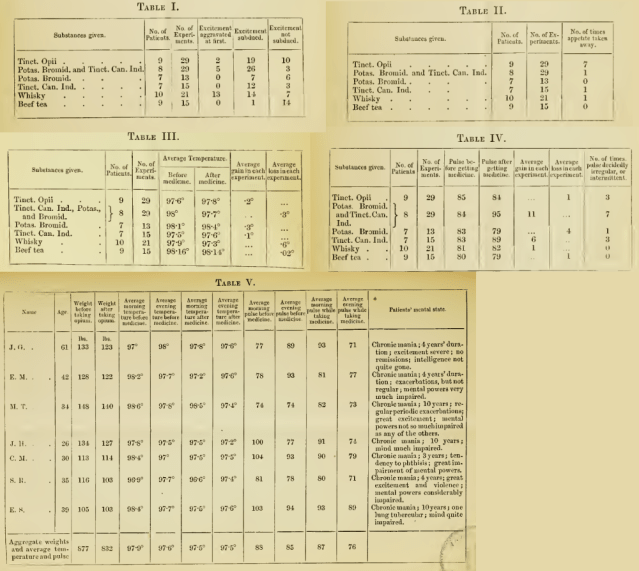
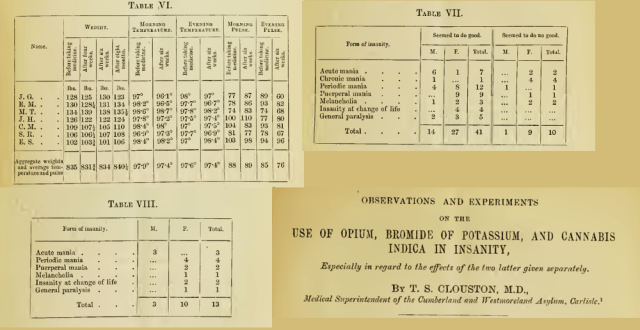
Tables from THE ACTION OF NEUROTIC MEDICINES measuring effects of opium, cannabis, potassium bromide, whiskey, and a ting called Beef tea. From year 1870.
Category: Dub Hemp
Hempwise for Earthe and People
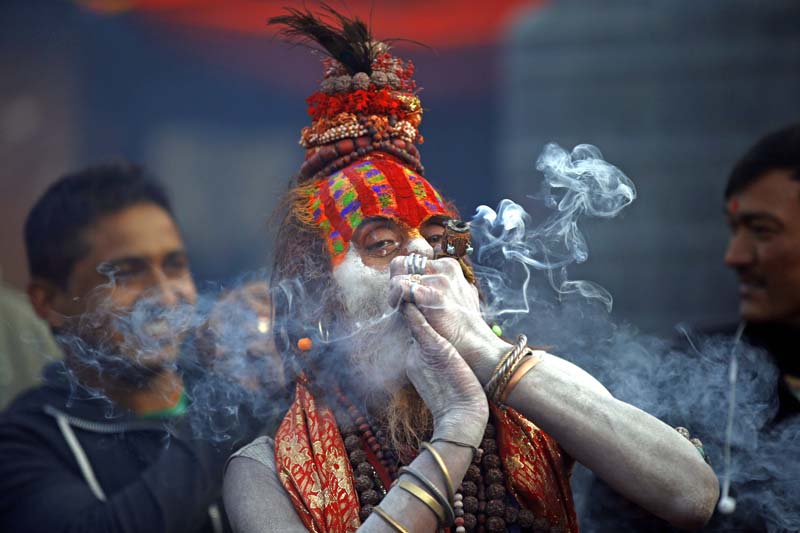
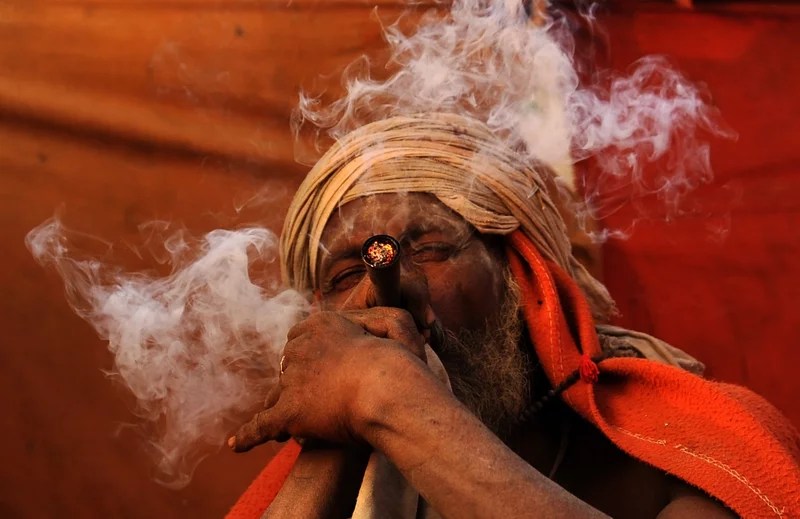
Sadhu reasoning on cannabis use
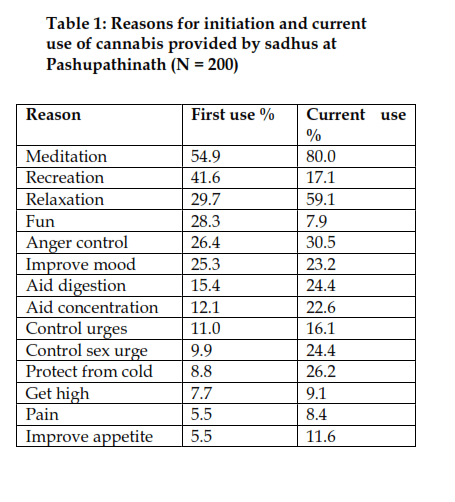
Found in: Cannabis, Lord Shiva and Holy Men: Cannabis Use Among Sadhus in Nepal
by Acharya SL, Howard J, Pant SB, Mahatma SS, Copeland J
(J Psychiatric Association of Nepal Vol .3, No.2, 2014 )
Photo source: Skanda Gautam/ THT
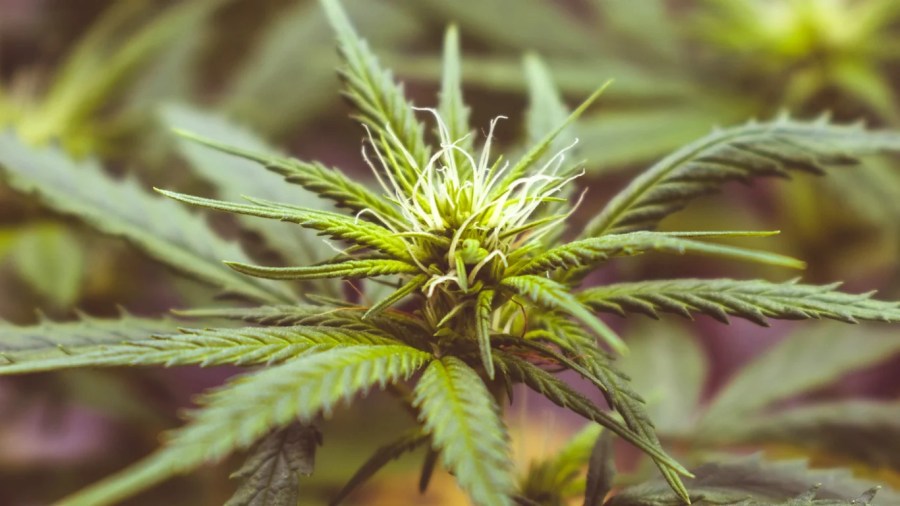
On Baba Ku
Baba Ku
Meanwhile, across the border from Persia in neighbouring Afghanistan, hashish aficionados have their own version of Sheik Haidar in the shape of a character called Baba Ku. So striking are the similarities between the stories of Sheikh Haidar and Baba Ku that they probably originate from the same source. Like Haidar, Baba Ku is characterised as a devout Sufi. He is celebrated for first bringing hashish to Afghanistan; he and his followers consumed the drug in prodigious quantities, regarding it as both a divine sacrament and a medicine. Baba Ku is generally acknowledged to be the founding father of cannabis culture in Afghanistan, and he is traditionally depicted as puffing on a giant hubble-bubble pipe. Again paralleling the Haidar legend, on the death of Baba Ku his disciples set up a shrine to him in the town of Balk in northern Afghanistan where they continued to cultivate a plot of cannabis in his memory. Pilgrims to the site were encouraged to smoke it up big time. Indeed, to this day in Afghanistan there are still hashish babas who venerate Baba Ku. Like the sadhus of India, they generally shun possessions other than their stash of hash and lead nomadic lives. However, from time to time they will gather together in smoking fraternities – summoned by a single mournful note blown through a giant conch shell – to fire it up in remembrance of the great Baba Ku. These Afghani hashish babas are some of the most serious smokers on earth and have been known to get through as much as an ounce (28g) per head at a single sitting. Another Islamic country strong on cannabis folklore is Morocco. Although a relative infant in terms of hashish production, the Moroccans have long been renowned for their love of kif – a marijuana and tobacco blend traditionally smoked in pipes. And they too have their patron saint of pot in the form of Sidi Hiri. Yet another Sufi Muslim, Sidi Hiri is said to have originally come to Morocco from Algeria bringing the sacred herb with him. Legend has it that he led a nomadic existence, sleeping rough in caves, wandering round the country, reciting the Koran, getting righteously ripped and turning on the locals to the joys of ganga.
Found in: Spliffs – Celebration of cannabis culture by Nick Jones. 2003.
ON ISHTAR
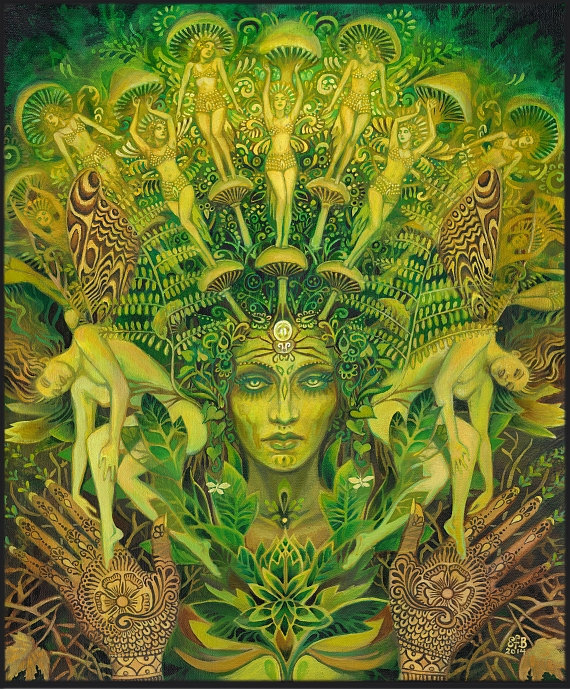
In ancient Sumeria, “Ishtar was held in high esteem as a heavenly monarch,” writes Jeanne Achterberg in Woman as Healer. “Her temples have been found at virtually every level of excavation.” The Ishtar Gate to the inner city of Babylon was one of the ancient wonders of the world. Also called the Queen of Heaven, Ishtar was a compassionate, healing deity. Her medicine kit likely included plant allies: a clay pot likely used for distillation of plant essences into medicines was found at a Sumerian grave site circa 5500 BC. The herb called Sim.Ishara, meaning “aromatic of the Goddess Ishtar,” is equated with the Akkadian qunnabu, or “cannabis,” writes Assyriologist Erica Reiner.
As the land of Sumer became a perpetual battlefield, Ishtar became the goddess of war and destiny, and became more sexualized, even as women were restricted from education and the healing arts.
In mankind’s first written story The Epic of Gilgamesh (circa 2000 BC), the cruel king Gilgamesh calls Ishtar a predatory and promiscuous woman, and rebukes her advances, just before taking off with his buddy Enkidu to chop down the great cedar forest. Gilgamesh’s repudiation of Ishtar, some scholars say, signifies a rejection of goddess worship in favor of patriarchy in ancient times. In ancient Babylon, around the spring solstice, people celebrated the resurrection of their god Tammuz, who was brought back from the underworld by his mother/wife Ishtar (pronounced “Easter” in most Semitic dialects). Flowers, painted eggs, and rabbits were the symbols of the holiday then, as now. Thus the goddess Ishtar resurrects every spring at Easter time, by way of the German goddess Ostara, “the divinity of the radiant dawn,” doubtlessly a reincarnation of Ishtar, who the Babylonians called “the morning star” and “the perfect light.” The biblical heroine Esther is also a descendant of Ishtar.
From: Tokin’ Women A 4000-Year Herstory
by Nola Evangelista (2015)
Image source: The Dryad Forest Nymph Goddess by Emily Balivet
ON GANJA BOMBING
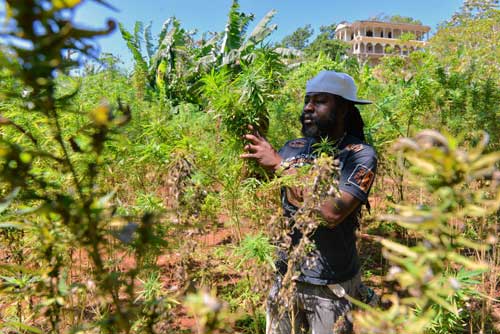
Despite the initiative by the Rastas those forces which harangued Bishop on the question of elections but turned a blind eye to the elections in Guyana still hoped to foment discontent from within. The elementary initiatives towards solving the needs of the working people were affected by the deteriorating security situation as the incidents of bombings and shootings increased, culminating in the June 19, 1980 bombing attack at Queens Park, St George. The Prime Ministers and the officials of the State had gathered to celebrate Labour Day when the bomb exploded. But no one on the platform was hurt; the force of the bomb killed three children and injured others. Some of the elements involved in this bombing campaign were involved in the large scale planting of ganja. This ganja was not for local consumption but for the international capitalist market and the big planters attempted to use the centrality of the weed in the lives of many youths as a leverage to move the Rastas after the previous attempt at demonstrations had failed. Ganja and its use pose a serious problem throughout the Caribbean for the way in which the trade is now linked to international gangsterism. Those imported psychologists and doctors who describe ganja as a dangerous narcotic forget that the British State imported ganja into the Caribbean up until 1907 to sell to the Indian indentured workers. The use of ganja by youths in the sixties and seventies was a principal method of social control and as soon as a youth was perceived by the state as rebellious the charge of – possession of ganja was always a useful weapon in the hands of the coercive apparatus of the state.
Found in Rasta, Ganja and Capitalism, from: THE RASTAFARIANS IN THE EASTERN CARIBBEAN by HORACE CAMPBELL. Source: Caribbean Quarterly, Vol. 26, No. 4, RASTAFARI (December 1980)
Image source: AP Photo/David McFadden
ON GANJA MUSIC
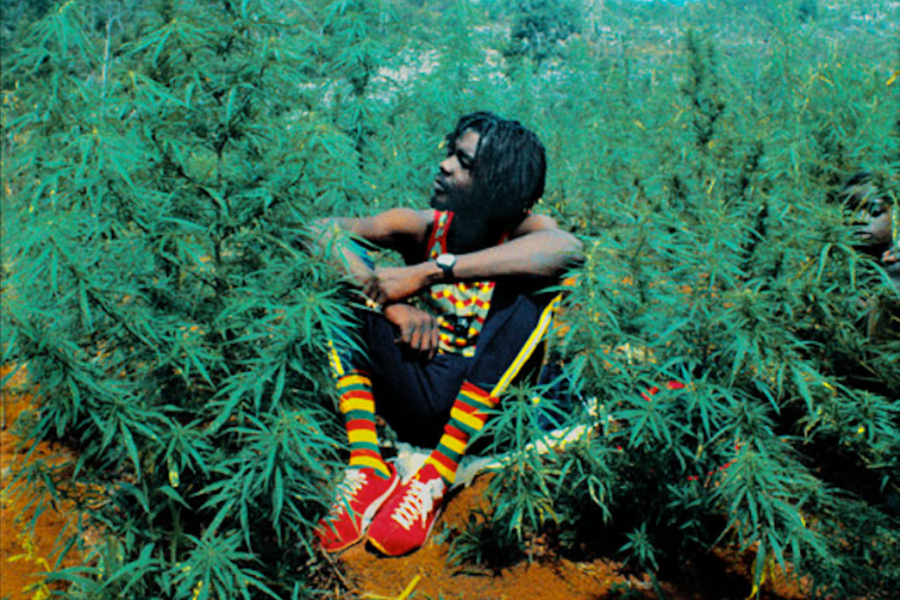
As the central sacrament to Rastafarians, the importance of ganja (marijuana) has been well documented and this importance extends into the sphere of Rasta-influenced Jamaican music. Rasta-influenced musicians were often outspoken advocates of ganja smoking, with songs full of exhortations to “smoke the herb”: Peter Tosh’s “Legalize It,” Bob Marley’s “Kaya” and “Easy Skanking,” Culture’s “International Herb,” Horace Andy’s “Better Collie,” Lee Perry’s “Free Up the Weed” and “Roast Fish, Cornbread and Collie Weed,” and Leroy Horsemouth Wallace’s “Herb Vendor” are a mere few of hundreds of such songs. Yet while it would probably be difficult to find a Jamaican musician of the roots era who was avowedly anti-ganja, some Jamaican musicians nevertheless felt that the prominence of this theme led to a distorted view of reggae in the world at large, as musicians played to the expectations of their international audiences. Paul Henton voiced a sentiment common among some Jamaican musicians, who felt that their colleagues sung about ganja at least in part “just because they know that the white people love it. If tomorrow morning the people or the fans say ‘Okay, we don’t want to hear anymore of this ganja stuff,’ they’ll stop singing about it and stop promoting it!”
Inside Jamaica, where ganja songs have flourished within several genres of Jamaican popular music (such as roots reggae and ragga), the situation has been more complex. Ganja was declared illegal in Jamaica in 1913 and for the decades since, its illegality has been a primary tool used by the ruling class in the social control of working-class Jamaicans. Correspondingly, it became a combustible element in the constellation of factors (including music, Rastafari, class conflict) that factor into Jamaica’s social tensions. As such, it is not surprising that ganja played a central role in the blended class, cultural, and political content that exploded in Jamaica in the 1970s and that arguably found its most powerful and passionate articulation in roots reggae. This centrality can be felt in the comments of legendary drummer Leroy “Horsemouth” Wallace: “The people respect you in Jamaica when you can put forty and fifty bag a ganja on a plane! We don’t call that drugs. That is ganja business. . . . We do those things like we are revolutionary. We put forty bag on a plane and feel good. . . . We send those so people in America could smoke the good ganja, not just for money alone.”
Found in: The Ganja Factor, from: DUB Soundscapes and shattered songs in Jamaican reggae by Michael E. Veal. Wesleyan University Press 2007.
Image source: Peter Tosh
ON EDIBLE AND MEDICINAL PLANTS
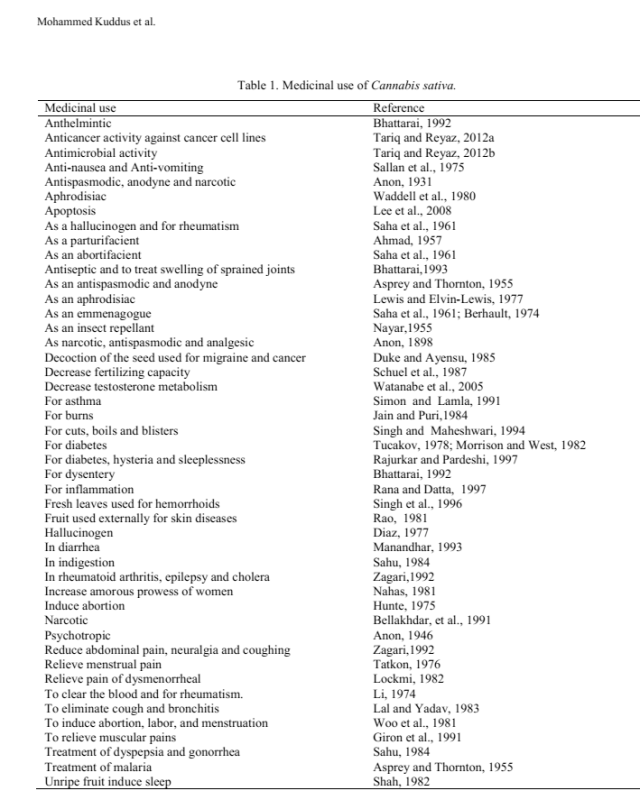
From Cannabis sativa: An ancient wild edible plant of India
By Mohammed Kuddus, Ibrahim A. M. Ginawi and Awdah Al-Hazimi in Emir. J. Food Agric. 2013.
ON THE ORIGIN AND HISTORY OF TRINATH WORSHIP
Chandra Kali was at the time living in the house of his father-in-law. He was thinking of introducing the worship of a common god, who might be worshipped by all classes, rich and poor, Brahman and Chandal, and by all creeds, Saktas, Baishnavas, and Shaivas, and the idea occurred to him of having the present worship at which ordinary and inexpensive things, such as ganja, oil, and betel-leaf, were alone to be used. Trinath (from Sanskrit Tri, three, and Nath, lord) is represented to be Brahma, Bishnu and Shiva, the Hindu Trinity in one. Being a ganja-smoker himself Ananda Kali may have also thought that by introducing the worship he would be able to save the ganja-smokers from disrepute, as then ganja could be consumed in the name of a god and under colour of doing a religious or pious act.
Religious aspect of the worship
The following translation of the Introduction to the Trinath Mela Panchali gives some idea of the subject :
“The universe consists of the earth, the heaven, and the nether world, and Trinath is the lord of these three worlds. There was an incarnation of God in the form of Gour (Chaitanya), who delivered· the sinners by preaching the name of Hari, but the Lord was not satisfied with this, and became concerned for the created, and soon he became incarnate again. Brahma, Bishnu and Shiva, gods in three forms, manifested themselves in one form. The one God, the Lord of the universe, seeing the miseries of mankind, came to their deliverance. Ananda (Ananda Chandra Kali, the originator) declares that the true and sincere worshippers of Trinath are sure to obtain salvation. Brahma, Bishnu, and Shiva met together and expressed their desire, to come to this world in one form to receive worship.
He is a truly pious man who worships Trinath, and blessings are showered on the worshipper. The worship should be made in a form in which the rich and the poor may equally join and may perform it easily. Only three things, each worth one pice, are required for this puja (form of worship). The things which please all must be selected. The offering should consist of siddhi (ganja), pan (betel-leaf), and oil, each worth one piece.
The votaries should assemble at night and worship with flowers. The ganja should be washed in the manner in which people wash ganja for smoking. The worshipper must fill three chillums with equal quantities of ganja, observing due awe and reverence. When all, the worshippers are assembled the lamp should be lit with three wicks, and the praises of Tri- should be sung. As long as the wicks burn, the god should be worshipped and his praises chanted. The god should be reverentially bowed to at the close of the puja. When the reading of the Panchali is finished, those that will not show respect to the Prasad (the offering which has been accepted by the god), i.e., chillum of ganja, shall be consigned to eternal hell, and the sincere worshippers shall go to heaven.”
From APPENDIX, NOTE BY BABU ABHIILAS CHANDRA MUKERJI, SECOND INSPECTOR OF EXCISE, BENGAL, ON THE ORIGIN AND HISTORY OF TRINATH WORSHIP IN EASTERN BENGAL, REPORT OF THE INDIAN HEMP DRUGS COMMISSION, 1893-94.
 OUT OF MANY COME DUB AND OUT OF DUB COME ONE