
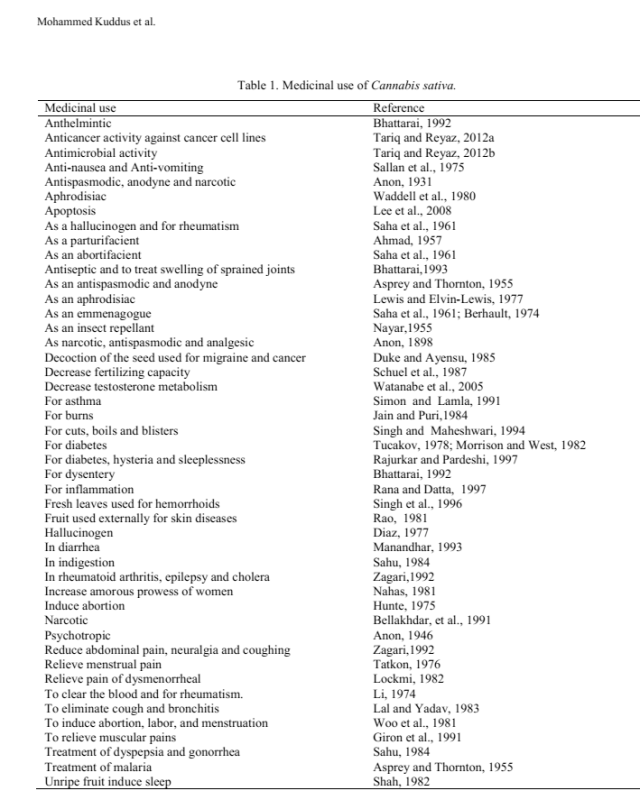
From Cannabis sativa: An ancient wild edible plant of India
By Mohammed Kuddus, Ibrahim A. M. Ginawi and Awdah Al-Hazimi in Emir. J. Food Agric. 2013.
Music, technology, science and wisdom of DuB culture.
From Cannabis sativa: An ancient wild edible plant of India
By Mohammed Kuddus, Ibrahim A. M. Ginawi and Awdah Al-Hazimi in Emir. J. Food Agric. 2013.
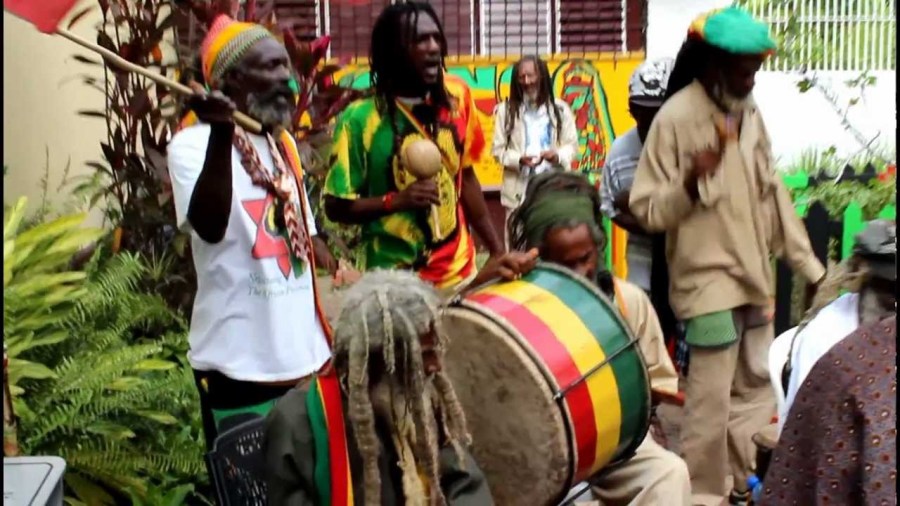
It was in the late 1930s that the Rastafarians began to gain a significant presence in Kingston, and by this time the pre-Rasta Burru peoples (a culture of people in rural Jamaica who were known for their drumming rituals a century ago) had fully settled in the slums.
Unlike the scenario in America, drumming in the Jamaican plantation system was officially tolerated, and the Burru-men, in addition to their role as timekeepers for slave labor, were keepers of African sound. In their search for “anciency” and cultural roots, the Rastafari knelt at the feet of the Burrus, appropriated their looks, style, and musics and, in return, imparted to them a political theology of race. But what was most important to this union of the Burrus and the early Rastafari were the rituals of sound that both communities instituted in the colonial ghettos of Kingston.
Saakana has traced the Burru drumming ritual back to a Ghanaian ceremony that took place around Christmastime. In the 1930s, the ritual of drumming was a customary way of welcoming discharged prisoners back into the folds of the ghetto community.
When the Rastafarians took over the ritual, they modified it, adding their own thematic obsessions to the African songs of insult and praise. From this came the ritual of the nyabinghi, which was said to mean “death to black and white oppressors” and became a term also used to describe the most orthodox members of the Rastafarian creed. In the sacred space of ritual, members of the faith meditated, reasoned with each other, debated Old Testament doctrine, and soundly criticized the exploitative and racist system they were living in. And they beat the drums, chanting down Babylon and conjuring up an alternate space of black community called “Africa.“
They did this in the yards of West Kingston, the same spaces that decades later would provide the genesis of the Jamaican sound systems.
Found in Bass History from
The Sound of Culture: Dread Discourse and Jamaican Sound Systems by LOUIS CHUDE-SOKEI
(Language, Rhythm, and Sound: Black Popular Cultures into the Twenty-first Century, 1997)
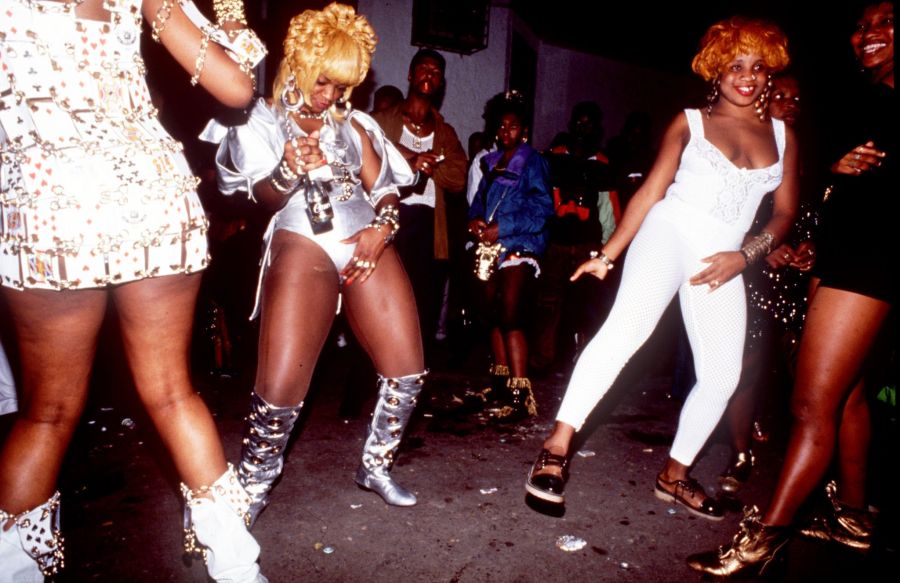
Dance events always have a name. Their appeal and consequent power converge around this naming, this rite of celebration, which takes the form of the latest dancehall and/or innercity lingua franca. This is crucial to attracting patrons.
Some of these names include “Ol’ time something come back again,” “Clean up yuh heart an come,” “Girl’s Dem Bashment,”“Bruck out, Bruck out,” “Raw and Rough,” “Fully Loaded,” “Gimme di light,” and “Rasta Jamboree,” among others.
Events are found throughout the calendar year, almost every night, all year round. Dancehall’s liturgical calendar is noteworthy simply because it persists regardless of season or state power and presents a challenge to conceptualizations of popular dancehall culture as “carnivalesque” in the Bakhtinian sense.
The dance is not just an event; it is a system of rules and codes, an institution.
Women adorn themselves according to the dictates of the current dancehall fashion. Patrons are aware of the latest dance moves, latest songs, debates, and artistes.
There are salutations, tributes, and paying of respect. The audience participates in the fundamental themes or moral codes that have been part of the dancehall scene, some from its inception.
Some of these include “friendship and love versus animosity,” “power and prowess of the rude boy/bad man,” “competition and struggle,” “sexuality and morality/ethics of the penis and vagina,” “celebrating the vagina, women, mother, girls,” “celebrating the DJ and/or sound system,” “dancing,” “the authority and divinity of Rastafari’s Haile Selassie and the Christian God,” “the essential herb,” “colour/class identity,” and “relationship between State institutions and the people.”
It is not uncommon to hear the selector calling his crowd to respond by showing of hands to, among other liturgical incantations, “from a bwoy nuh badda dan you, han up inna di air” (put your hand in the air if you are the baddest). Similarly, the selector will call for a showing of hands by those who love God, and the audience will respond, after which a song that typifies the sentiment will be played. There is a dynamic relationship between the patrons, selectors’ conversations, DJ music, and dance.
Once the event’s tone has been set in order, the purpose takes over. Dance events have been characterized by music—how, why, and by whom it is played.
Stolzoff identified two major types of sound system dances: the “sound system clash,” a competition between two or more sound systems, and the “juggling” dance, in which sound systems play noncompetitively through such “performance modes” as “juggling,” “clashing,” “reality,” “culture,” “sacrifice,” and “war”.
Reyes (1993), on the other hand, identified two types of dance events: the “session” and the “dance”.
The session is usually hosted by a bar, where admission is free and financial return is from beverage sales. The dance usually happens on a Friday or Saturday, a sound system is contracted, and the event is promoted through advertisement to secure entrance fees.
The risk in organizing a dance for profit is higher.
Found in DANCEHALL EVENTS from
Kingston’s Dancehall: A Story of Space and Celebration by Sonjah Stanley-Niaah
(space & culture vol. 7 no. 1, february 2004 )
While conducting research in Senegal I was very fortunate to develop a close relationship with a 38 year old Gambian Baye Faal named Moussa N’Gom, who also happens to be one of the best known and most highly respected pop musicians in the region. A founding member of the Gambian group Guelewar back in the late 1970s, Moussa went on to become a lead vocalist and songwriter with the popular Senegalese band Super Diamono. Possessing a keen awareness of the world outside West Africa-as he has travelled and
performed throughout Europe and North America-it was Moussa who convinced me of the very close connections that exist between the Baye Faal and the Rastafari.
During the various trips he made to New York, London and Toronto, Moussa often found himself in the company of local West Indian Rastas. Bonds of friendship quickly developed between the two as they discovered how much they shared in common, e.g. a love of music and ganja, a deeprooted spirituality and a strong commitment to African unity and black solidarity. And it was from direct contacts such as these that Moussa gained his knowledge, appreciation of and respect for the Rastafari and the more universal aspects associated with their movement (although, like most Baye Faal, he finds the Rastafarians’ deification of Haile Selassie and reliance on Judaeo/Christian-based religious teachings thoroughly misguided). As Moussa, always one to emphasise the inherent unity rather than divisions, was in the habit of pointing out:
Like Rastas, the Baye Faal are totally free and flexible, and this is what is most
important-the true Rasta man and Baye Faal is a free man and not a slave to
anyone or anything. We make our own rules, and we are accountable only to God
and his prophets. Some Baye Faal smoke, some don’t, some drink alcohol, some
don’t, some pray, some don’t. You see, it is up to us what we do. And, like Rastas, we try to set an example to the world of how a good man should live-that is, not offending God and not offending one’s fellow man.
From The Baye Faal of Senegambia: Muslim Rastas in the Promised Land by Neil J. Savishinsky.
Published in: Africa: Journal of the International African Institute, Vol. 64, No. 2 (1994)
In India, musical modes are called “ragas,” or “states of mind.” A raga can also be defined as a theoretical scale, as a set of proportional intervals, or as a complex of sounds, each of which has a psychological impact or precise significance. Taken as a whole, they create an emotive atmosphere or state of mind.
Indian psychology envisages nine different sorts of mood or affective states, which are called rasas, “flavors.” They are thus linked to numerical factors, giving us an interesting glimpse into the workings of the brain’s mechanisms and the nature of our aesthetic and emotional reactions. The emotive atmosphere of the ragas is often associated with those that prevail at different times of day and night, or else of the sea sons that punctuate the year’s cycle. Like the vegetal world, we react differently in the morning or the evening, in the spring or autumn.
Modal music can only be improvised, since preset forms of melody adversely affect modal consciousness, its internal vision centered on the scale of the mode and the atmosphere it creates. The musician should therefore cruise freely in the inner ambiance created by the mood without ever coming out of it. It is a very intense and a very extraordinary experience, which requires total abstraction from the outer world. In fact, it is a form of meditation that can easily become mystical in character.
The listener is also gradually influenced by the nature of the mode, becoming immersed in a sort of sound bath, which evokes a well-defined feeling. The listener gradually identifies with the emotional scenario evoked. This is why a good performance of modal music can have a profound effect on the audience, making them melancholic, wary, calm, enterprising, aggressive, or tender, according to the atmosphere created by the performer.
In actual fact, any music that seeks to move us – such as what we know as romantic music – requires us to abandon ourselves to the feeling evoked, which takes precedence over technical format. That is why Greek warriors were advised not to listen to certain modes, which stimulate a kind of erotic languor. The Dorian mode was recommended, since it stimulates courage and energy. During the Middle Ages, modes deemed to be sensual were forbidden by the church, always sexophobic, not to speak of the augmented fourth, which does in fact open horizons onto the invisible, and was considered to be diabolical, the diabolus in musica.
From Music. The language of the Gods, found in:
Shiva and the Primordial Tradition FROM THE TANTRAS TO THE SCIENCE OF DREAMS by Alain Danielou (2003.)
A further possible effect of music upon the body is described by Bob Larson, the one-time rock guitarist who gave up his playing becoming a Christian. Larson writes :
“Drs. Earl W. Flosdorf and Leslie A. Chambers found in a series of experiments that shrill sounds projected into a liquid media coagulated proteins. A recent teenage fad was that of taking soft eggs to rock concerts and placing them at the foot of the stage. Midway through the concert the eggs could be eaten hard-boiled as a result of the music. Amazingly few rock fans wondcred what that same music might do to their bodies.”
Not the most appetizing of thoughts. Anyone for hard-boiled punk rocker?
From Assessment : Music, Man and Society, found in:
The secret power of music by David Tame (1984.)
Original cited article: THE DENATURATION OF PROTEINS BY SOUND WAVES OF AUDIBLE FREQUENCIES
And, of course, there were the clashes with the police. The ganja, and the guns, and the “pressure” produced a steady stream of rude boys desperate to test their strength against the law, and the judges replied with longer and longer sentences. In the words of Michael Thomas (1973), every rudie was “dancing in the dark” with ambitions to be “the coolest Johnny-Too-Bad on Beeston Street”. This was the chaotic period of ska, and Prince Buster lampooned the Bench and sang of “Judge Dread”, who on side one, sentences weeping Rude Boys (“Order! Order! Rude Boys don’t cry!”) to 500 years and 10,000 lashes, and on side two, grants them a pardon, and throws a party to celebrate their release. The dreary mechanics of crime and punishment, of stigmatisation and incorporation, are reproduced endlessly in tragi-comic form on these early records, and the ska classics, like the music of the “burra” which preceded them, were often a simple celebration of deviant and violent behaviour. Sound system rivalries, street fights, sexual encounters, boxing matches, horse races, and experiences in prison, were immediately converted into folk-song and stamped with the ska beat. The disinherited Dukes and Earls, the Popes and Princes of early ska came across as music-hall gangsters and Prince Buster warned in deadly earnest, with a half-smile that “Al Capone’s guns don’t argue”.
But in the world of “007” where the rude boys “loot” and “shoot” and “wail” while “out on probation”, “the policemen get taller”, and “the soldiers get longer” by the hour; and in the final confrontation, the authorities must always triumph. So there is always one more confrontation on the cards, and there is always a higher authority still, and that is where Judgement Day works itself back into Reggae, and the Rastas sing of an end to “sufferation” on the day when Judge Dread will be consumed in his own fire. The Rastafarian influence on reggae had been strong since the earliest days—ever since Don Drummond and Reco Rodriguez had played tunes like Father East, Addis Ababa, Tribute to Marcus Garvey and Reincarnation to a receptive audience. And even Prince Buster, the “Boss,” the Main Man, the individualist par excellence, at the height of the anarchic Rude Boy period, could exhort his followers in Free Love, to “act true”, to “speak true”, to “learn to love each other,” advising the dissident rudies that “truth is our best weapon” and that “our unity will conquer.” In the burlesque Ten Commandments, Prince Buster is typically ambivalent, proselytising, and preaching, and poking fun all at the same time; but the internalisation of God which marks the Rasta Creed is there nonetheless behind all the blustering Chauvinism:
These are the ten commandments of man given to woman by
me, Prince Buster, through the inspiration of I.
As the decade wore on, the music shifted away from America towards Ethiopia, and the rude boys moved with the music. Racial and class loyalties were intensified, and, as the music matured, it made certain crucial breaks with the R. and B. which had provided the original catalyst. It became more ‘ethnic’, less frenzied, more thoughtful, and the political metaphors and dense mythology of the locksmen began to insinuate themselves more obtrusively into the lyrics. Groups like the Wailers, the Upsetters, the Melodians and the Lionaires emerged with new material which was often revolutionary, and always intrinsically Jamaican. Some rude boys began to grow the dreadlocks, and many took to wearing woollen stocking caps, often in the green, gold and red of the Ethiopian flag to proclaim their alienation from the West. This transformation (if such a subtle change of gear deserves such apocalyptic terminology), went beyond style to modify and channel the rude boys’ consciousness of class and colour. Without overstressing the point there was a trend away from the undirected violence, bravado and competitive individualism of the early sixties, towards a more articulate and informed anger; and if crime continued to offer the only solution available, then there were new distinctions to be made. A Rude Boy quoted in Nettleford (1970) exhibits a “higher consciousness” in his comments on violence:
It’s not the suffering brother you should really stick up it is
these big merchants that have all these twelve places… with the
whole heap of different luxurious facilities…, what we really
want is this equal rights and justice. Everyman have a good
living condition, good schooling, and then I feels things will be
much better.”
I would suggest that, as the Rastas themselves began to turn away from violent solutions to direct the new aesthetic, the rude boys, steeped in ska, soon acquired the locksmen’s term of reference, and became the militant arm of the Rasta movement. Thus, as the music evolved and passed into the hands of the locksmen there was an accompanying expansion of class and colour consciousness through the West Indian community. Of course, I would not isolate the emergence of a “higher consciousness” from larger developments in the ghettoes and on the campuses of the United States. Nor would I dismiss the stimulative effect of the Jamaican Black Power movement which, by the late sixties, was being led by middle-class students and was clustered around the University of the West Indies. But I would stress the unique way in which these external developments were mediated to the Rude Boy (in Brixton as well as Back O’Wall), how they were digested, interpreted and reassembled by the omniscient Rasta Logos situated at the heart of reggae music. In spite of Manley and Seaga, reggae remained intact. It was never dirigible, protected, as it was, by language, by colour, and by a culture which had been forced, in its very inception, to cultivate secrecy and to elaborate defences against the intrusions of the Master Class.
Moreover, the form of reggae itself militated against outside interference and guaranteed a certain amount of autonomy. Reggae reversed the established pattern of pop music by dictating a strong repetitive bassline which communicated directly to the body and allowed the singer to “scat” across the undulating surface of the rhythm. The music and the words are synchronised in good reggae and co-ordinated at a level which eludes a fixed interpretation. Linguistic patterns become musical patterns; both merge with the metabolism until sound becomes abstract, meaning non-specific. Thus, on the “heavy” fringes of reggae, beyond the lucid but literal denunciations of the Wailers, Count Ossie and the Mystic Revelation of Ras-Tafari condemn the ways of Babylon implicitly, taking reggae right back to Africa, and the rudie dee-jays (like Big Youth, Niney, IRoy and U-Roy) threaten to undermine language itself with syncopated creole scansion and an eye for the inexpressible.
Language abdicates to body-talk, belief and intuition; in form and by definition, reggae resists definition. The form, then, is inherently subversive; and it was in the area of form that the Jamaican street boys made their most important innovations.
From Dick Hebdige: REGGAE, RASTAS & RUDIES, Music and the overthrow of form,
Resistance Through Rituals: Youth subcultures in post-war Britain
Edited by Stuart Hall and Tony Jefferson (1975)
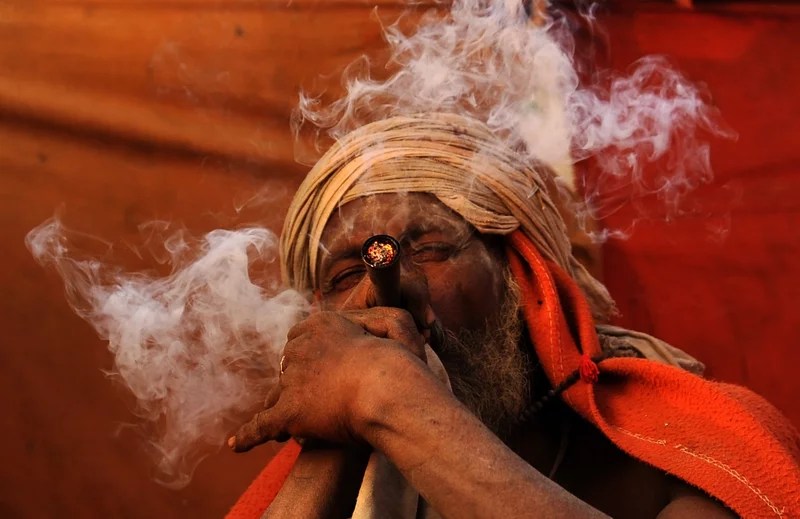
Chandra Kali was at the time living in the house of his father-in-law. He was thinking of introducing the worship of a common god, who might be worshipped by all classes, rich and poor, Brahman and Chandal, and by all creeds, Saktas, Baishnavas, and Shaivas, and the idea occurred to him of having the present worship at which ordinary and inexpensive things, such as ganja, oil, and betel-leaf, were alone to be used. Trinath (from Sanskrit Tri, three, and Nath, lord) is represented to be Brahma, Bishnu and Shiva, the Hindu Trinity in one. Being a ganja-smoker himself Ananda Kali may have also thought that by introducing the worship he would be able to save the ganja-smokers from disrepute, as then ganja could be consumed in the name of a god and under colour of doing a religious or pious act.
Religious aspect of the worship
The following translation of the Introduction to the Trinath Mela Panchali gives some idea of the subject :
“The universe consists of the earth, the heaven, and the nether world, and Trinath is the lord of these three worlds. There was an incarnation of God in the form of Gour (Chaitanya), who delivered· the sinners by preaching the name of Hari, but the Lord was not satisfied with this, and became concerned for the created, and soon he became incarnate again. Brahma, Bishnu and Shiva, gods in three forms, manifested themselves in one form. The one God, the Lord of the universe, seeing the miseries of mankind, came to their deliverance. Ananda (Ananda Chandra Kali, the originator) declares that the true and sincere worshippers of Trinath are sure to obtain salvation. Brahma, Bishnu, and Shiva met together and expressed their desire, to come to this world in one form to receive worship.
He is a truly pious man who worships Trinath, and blessings are showered on the worshipper. The worship should be made in a form in which the rich and the poor may equally join and may perform it easily. Only three things, each worth one pice, are required for this puja (form of worship). The things which please all must be selected. The offering should consist of siddhi (ganja), pan (betel-leaf), and oil, each worth one piece.
The votaries should assemble at night and worship with flowers. The ganja should be washed in the manner in which people wash ganja for smoking. The worshipper must fill three chillums with equal quantities of ganja, observing due awe and reverence. When all, the worshippers are assembled the lamp should be lit with three wicks, and the praises of Tri- should be sung. As long as the wicks burn, the god should be worshipped and his praises chanted. The god should be reverentially bowed to at the close of the puja. When the reading of the Panchali is finished, those that will not show respect to the Prasad (the offering which has been accepted by the god), i.e., chillum of ganja, shall be consigned to eternal hell, and the sincere worshippers shall go to heaven.”
From APPENDIX, NOTE BY BABU ABHIILAS CHANDRA MUKERJI, SECOND INSPECTOR OF EXCISE, BENGAL, ON THE ORIGIN AND HISTORY OF TRINATH WORSHIP IN EASTERN BENGAL, REPORT OF THE INDIAN HEMP DRUGS COMMISSION, 1893-94.
We may have first learned the secret of drinking alcohol from animals. The ancient Greeks believed thus, and a legend told that people first learned to drink from the apes. Studies show that chimpanzees and other apes do indeed like alcohol, and get drunk. Many animals seek out intoxicants, and most will partake of them to excess, given the chance. Perhaps the most common example in temperate zones is birds drunk on fermented berries, wheeling about, crashing into the ground, and generally making fools of themselves. And while recent experiments by Ronald Siegel suggest that some or all of the intoxication may be due to secondary substances in the berries rather than alcohol, anyone witnessing the event might thereafter try the berries for themselves.
David Livingstone reported how African elephants sought out fermented palm fruits, sometimes traveling unusual distances to find and ingest them. And they did get intoxicated, staring off, trumpeting loudly, and separating out from the group.
The Romans reported that the Gauls were so fond of wine that they would trade their children for it. That they went crazy when they drank it, running about in frenzy and fighting each other. The early Romans themselves were on the temperate side, and women were completely forbidden to drink on grounds that it led to lust and adultery.
In later Roman history, both sexes seem to have embraced excess in wine — twenty-five million gallons a year — for exactly the same reasons.
The Greeks, by classical times, appear to have been heavy drinkers, despite their reputation for moderation. When the Scythian philosopher Anacharsis visited Athens in 600 BC he was somewhat repelled by the behavior he witnessed. He said that there were three kinds of grapes, one for pleasure, one for drunkenness, and one for disgust.
When asked how to avoid excess in wine, Anacharsis advised observing those who did not. The Scythians themselves had no wine. They smoked hemp.
From: Pharmako/Poeia – Plant Vowers, Poisons, and Werb craft by Dave Pendell, 1995.


 OUT OF MANY COME DUB AND OUT OF DUB COME ONE