On ragga rude boy

#raggamuffin

Clint Eastwood and General Saint


Although Seaga‘s Jamaica, Thatcher‘s England, and Reagan‘s America gave ragga the kind of painful birth necessary for their mythic function, they really were always there. They were overshadowed by the spectacle of Rasta and its pious moralisms, but they were there nonetheless, stalking Jamaica’s neocolonial streets and consuming American cowboy and gangster films as well as the Old Testament and Pentecostalism.
They existed within Rasta from the moment it defined itself as an urban phenomenon and as a place for those suppressed by the hierarchical and color-stratified social structure of Jamaica.
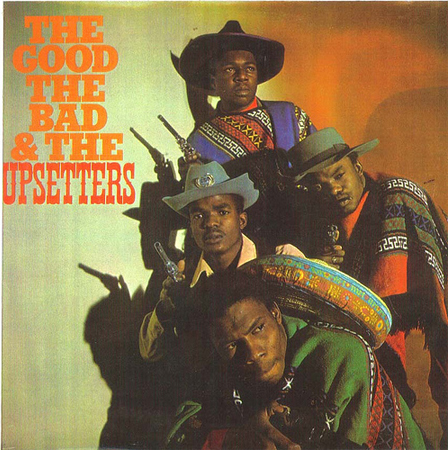
Design Legacy: A Social History Of Jamaican Album Covers

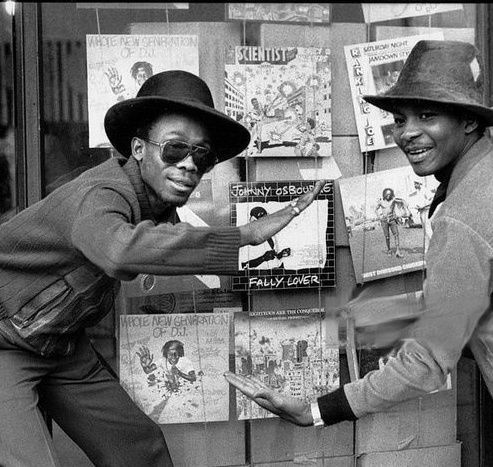
During the sixties, before the hegemony of Rasta in the consciousness of ghetto sound, the earliest manifestation of the ragga can be located in the rude-boy phenomenon which swept the tiny island. The rudies, like today’s “gangbangers” in America, were young males who had little access to education and were victims of the incredible unemployment endemic to Third World urban centers. Their political consciousness was as developed as the Rastafari, but where the Rasta solution was one which often refused to engage directly with the harsh realities of ghetto and Third World life and frequently got lost in cloudy moments of rhetoric and myth (“roots and culture“), the rudies clung fiercely to “reality“-that trope central to today’s ragga/dancehall culture. They terrorized the island, modeling themselves after
their heroes from American films and glorying in their outlaw status. They killed, robbed, and looted, celebrating their very stylish nihilism. And ska and reggae – especially DJ-reggae, the beginning of rap/hip hop – were their musics.

Today the dreadlocks vision has been superseded-at least in the realm of sound and culture-by the rudie vision. The crucial differences between them can be seen quite vividly in their relationship to Babylon. Where in Rasta and other forms of popular Negritude there has always been some degree of nostalgia for a precolonial/preindustrial/precapitalist Africa, raggamuffin culture is very forward looking and capitalist oriented-as are most black people, despite the fantasies of many self-appointed nationalist leaders. These rudies focus their gaze, instead, on America, absorbing commodity culture from the fringes of the global marketplace, responding to it positively.

This means that in the context of a Third World ghetto where there are more guns per capita than anywhere else in the world, where legitimate employment is often a fantasy, where the drug trade and music provide the only available options for success, these young men find affirmation in the various messages that radiate out from America, an America that is not the “center” but rather an imagined source of transmission. Messages like The Godfather get picked up and translated into island style.

For example, one of the titles of utmost dancehall respect is “don.”

Shabba Ranks “Shine & Criss”


The raggamuffin pantheon is full of DJs with names like Clint Eastwood, Johnny Ringo, Al Capone, Josey Wales, and Dillinger; and today’s dons boast names like Bounty Killer, Shabba Ranks (named after a famous Jamaican gunman), and John Wayne. Also, the Jamaican underworld has always been full of characters who inscribed themselves into ghetto myth by renaming themselves in much the same way.

Male identity in this context is a necessary pastiche, and the allegorical representations of America’s dreams of itself become rewritten with a pen soaked in the blood of colonialism, slavery, and black ghet-to style. The gunfighter/outlaw image has always been there in reggae; it is now, however, without overt references to the Western world as the “Sheriff,” as in Bob Marley and the Wailers‘ classic “I Shot the Sheriff.”

For the ragga, this metaphor is no longer apt, for now they shoot each other in a lawless postcolonial terrain. Indeed, Ninjaman has described Jamaica as a “Cowboy Town.”

Sting 2012, Jamaica Gleaner


These names-and the notion of crime as political/cultural resistance that they signify – were there during Rasta‘s moment, but where the more Afrocentric embraced the Marley vision, the ghetto youth, the “bad-bwoys,” were smuggling in specialized weaponry like M16s, Glocks, and Bush-masters, killing each other and following their favorite sound systems around the island.

And, of course, the cocaine and marijuana trade was booming. In fact, it was booming in such a way that in the 1980s a few of the more enterprising Yardies invested some of this money which came to the ghetto in -believe it or not- state-of-the-art digital computer technology. Thus began what Jah Fish (Murray Elias), an avid follower of Jamaican music, has called the “the modem era” of Afro-Caribbean sound and culture.

Found in:

Post-Nationalist Geographies: Rasta, Ragga, and Reinventing Africa
Author: Louis Chude-Sokei
Source: African Arts, Vol. 27, No. 4 (Autumn, 1994),
Published by: UCLA James S. Coleman African Studies Center
Stable URL: http://www.jstor.org/stable/3337324

On cannabis in colonial Africa

#cannabis

Jah Billah says:
This article delineates pre-colonial and colonial use of cannabis in Africa. Starting with prehistoric cultivation 1300 BC in Ancient Egypt, and 2000 years ago in Madagascar. Going over North African and Sub-Saharan cannabis cultures, we learn that cannabis use was associated with coffee and that in Ethiopian language plant was once called esha tenbit “prophecy plant”. But what we choose to highlight here is documented use of tobacco as a colonial weapon against African cannabis cultures:

Cannabis Commerce and Legality

African cannabis markets were earliest documented in 13th-century Egypt, and 17th-century Southern Africa. Europeans widely observed commercial and exchange markets in all continental regions during the 1800s and early 1900s. In the Maghreb, 19th-century markets were highly formalized. By 1870, governments in precolonial Morocco and Ottoman Tunisia both began selling annual monopolies to their cannabis (and tobacco) trades. These monopolies continued under French rule until 1954.

European-controlled trades arose within colonial contexts and mostly supplied hard laborers. Three major trade regions existed, including the Maghreb. In South Africa, European merchants and settlers farmed and traded in cannabis from the late 1600s into the 1900s. Portuguese Mozambique also supplied South African laborers via exports to British Transvaal between 1908 and 1913. Miners were prominent consumers in colonial Southern and Central Africa. Finally, cannabis trades in western Central Africa included local traders stocking locally grown cannabis, as well as formal exports from Portuguese Angola to São Tome and Gabon during the 1870s to 1900s.

Even as these trades developed, colonial regimes increasingly suppressed cannabis. Rarely, colonial laws
rose upon indigenous prohibitions, as in Madagascar, where Merina royalty forbade cannabis by 1870,
decades before the French. Colonialists considered African cannabis an Eastern hindrance to Europe’s
civilizing mission. “The tobacco introduced by the Portuguese has contended successfully against the stupefying or maddening hemp […] from the far Muhammadan north-east,” told a British administrator in Belgian Congo in 1908.


Cannabis-control laws were enacted in Africa generally earlier than elsewhere worldwide, and were stricter too. Initial laws mostly aimed to improve public health, primarily by prohibiting behaviors considered detrimental to “native” health. Many laws clearly served ulterior motives, particularly labor control and religious proselytizing. British Natal’s 1870 law aimed to control Indian laborers, while Portuguese Angola’s 1913 law targeted colonial troops while also pushing farmers toward tobacco production. Cannabis was banned in most colonies by 1920. The plant drug first appeared in an international drug-control convention in 1925, based on the request of South Africa’s white minority government supported by newly independent Egypt, whose conservative authorities had suppressed cannabis since 1868 to control laborers.
Colonial authorities accepted and encouraged some drug crops—particularly tobacco, tea, and coffee—but cannabis was excluded, despite the existence (around 1840–1940) of an international market for Western pharmaceutical preparations of cannabis, supplied primarily from British India.


From:

Cannabis and Tobacco in Precolonial and Colonial Africa
Chris S. Duvall, 2017.
https://doi.org/10.1093/acrefore/9780190277734.013.44

Odgprod – Best of 2023

#odgprod

Odgprod presents best of best of their ever prolific 2023 label output. Join in for 21 track journey trough boundless lands of future dub.

Dubmatix – Full Discography End of Year SALE

#dubmatix Gwan over to Dubmatix BandCamp music page and bag entire Dubmatix discography for 35$ or more.
That’s 70 releases including latest Rock & Sway with Al Pancho!
Dubmatix been consistent since day one in delivering that finest blend possible of old school sound we all love alongside keeping in beat with with many a youthman’s style of delivery like jungle, trap and dancehall, and as reward for us keeping in tune with all that goody good goods,
this comes as End of Year Sale that is brilliant opportunity to load up your digital crates!

Here’s how you do it:
On every release page there is the option to purchase the “Full Digital Discography” – click on that link and you’re ready to go.

BENJAMIN ZEPHANIAN 1958 – 2023

As sad news of passing forth one BENJAMIN ZEPHANIAN circumambulates the globe, mass media gaslight the culture by calling our great elder warrior an “actor” while setting aside the fact man was father to entire art genre “DUB POETRY”. Rasta in power of life long commitment to social justice and peace.
So instead of sharing biographies or obituaries I would rather share this 1996 masterpiece available on Bandcamp:

Bandulu Dub feat Sickandah – Ital Conscious Dub

#banduludub

Bandulu Dub one of the hardest working man in dubwise promotions comes with brand new track featuring Sickandah. Song about time with chill out vibes. Niceness!

Sensational VS Abu Ama

#sensational

Sensational

If you don’t know by now step correct and re-frame Sensational of Crooklyn fame: subterranean lyrics over over lo fi dub noise beats, same as it ever was.
Originally grazing with Wordsound label, post apocalyptic illbient stable, alongside Bill Laswell rocking blue light torch of avant-garde hip hop and bass music since 1999, here comes Sensational VS Abu Amu with 2 tracks that don’t disappoint.


Heavyweight Roots & Dub Vinyl You Won’t Hear On Spotify PT.2

#DUB #VINYL

Top notch vinyl selection played on top shelf turntables blasting top sound dub siren for some top reggae time!

Chapter one here.

L’ENTOURLOOP – En Roue Libre Mix – Special Radio Nova

#LENTOURLOOP

Kings of Reggae Hip Hop DJ L’Enterloop sets alway coming in with flawless mix and fresh blends full of mashups, remixes, nuff of your favorite samples, dubplates and vibes. Chilling in with 1.8M views in little over 6 months ago, this is your soundtrack to cool.

Vedic Roots Sound System @ Southall

#VedicRoots

Hour long super cool vibes Vedic Roots session for Boiler Room at Southall.

Cutty Ranks in Rub A Dub style

#cuttyranks
Original Stopper Cutter Bomber inna lively performance for Teach Dem!

Vinyl Mix Selection by Sista Zine

#steppers #dub
Fulljoy!