On Dancehall Queen


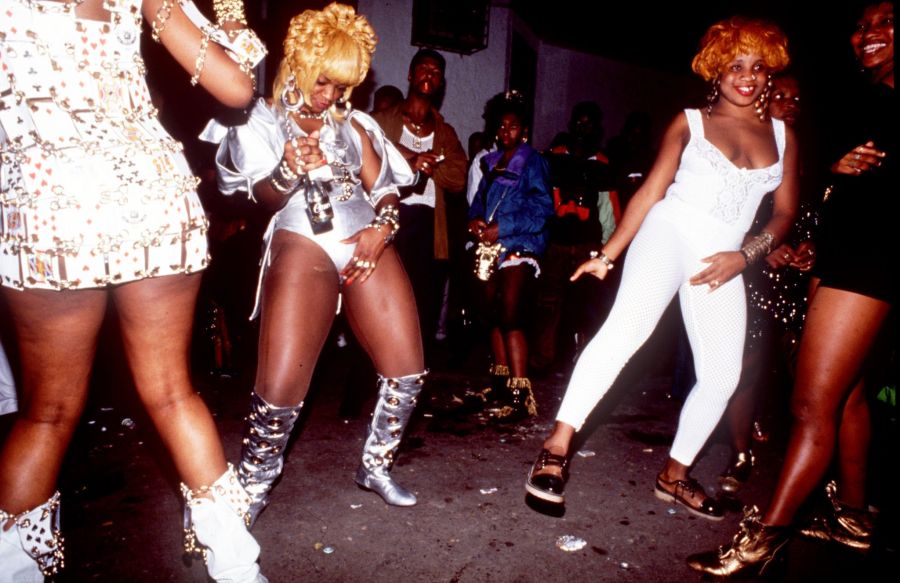
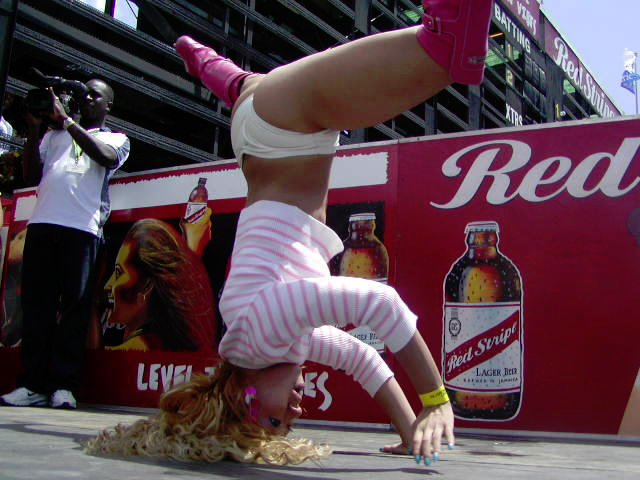
Key participants consistently create, or transcend boundaries, notably, in the form of categories, spaces and material reality. The phenomenon of Dancehall queen is a crucial example. Dancehall queens emerged as informal community celebrities and have existed since the 1970s. Since Poochiloo and other less acknowledged queens of the Dancehall, Carlene Smith (the 1992 media proclaimed queen) in particular, and Stacey (crowned queen in 1999), have ushered in a new era in Dancehall: the rise of image, style, appeal, and a ‘narrative of queen’.

However, this was an old phenomenon that featured in such traditional forms (both secular and religious) as Kumina, a Congo-derived Afro-Jamaican religion (with Mrs Imogene ‘Queenie’ Kennedy as the most popular), Jonkonnu, Bruckins Party and Queen Party.

This is paralleled by the ‘Mother’ or chief spiritual arbiter in Revival and Burru’s ‘Mother Lundy’. Additionally, there are Carnivals in the wider Caribbean (and its diaspora) where carnival queens are crowned based on authenticity, appropriate movements, mannerisms and dress. The ways in which the presence of ‘queen’ within both secular and religious settings mimics the status and symbol of great African queens, especially queen mothers of the Akan tradition such as Yaa Asantewa, Queen Mother of Ejisu whose war against the British is a well-known fact of West African history,


Ras Tafari’s Empress Menen, as well as the colonial legacy of the British Queen, is noteworthy.

The idea of ‘queen’ as a category, once simplified, reveals the consistently elevated place of woman as a key counterpart of the male ‘king’, in both the popular and religious realms. In this sense, within the Diaspora, the pervasiveness of a central female persona is consistent with African popular and sacred traditions as well as the kinship patterns that are matrilineal and/or matriarchal in character.

For the dancer and the queen in particular, Dancehall is a stage, a status
granting institution outside the socially constricting everyday, a space to emerge and maintain stardom on the basis of physical attributes and/or ability. It is also platform through which women define the terms and conditions of success, style, contest, while creating place and space for other women beyond constricting social conditions.


Text source:

Sonjah Stanley Niaah (2004) Making space: Kingston’s Dancehall
culture and its philosophy of ‘boundarylessness’
,
African Identities, 2:2

Image source:
Dancehall Queen Junko

On selecting Madonna in a dance

It was not unusual for the selector to play Latin, Hip Hop, Disco, Rock & Roll, other music, including songs like Madonna’s ‘Like a Virgin’, and ‘Ain’t Nothing Going on but the Rent’ as examples. Of course these constitute hit songs in their particular genres and their popularity catapulted them into the Jamaican dance scene where they are baptized in Dancehall aesthetic and practice (‘dance- hallified’), especially through dance styles such as the ‘bubble’ along with other directions from the selector. These directions continued in the typical Dancehall style until dawn when the event ended.

From: The dance, found in:
Making space: Kingston’s Dancehall culture and its philosophy of ‘boundarylessness’.
Author: Sonjah Stanley Niaah. 2004. African Identities.
Image source: PASSA PASSA KINGSTON JAMAICA

ON DANCEHALL CULTURE IN THE BAKHTINIAN SENSE

Dance events always have a name. Their appeal and consequent power converge around this naming, this rite of celebration, which takes the form of the latest dancehall and/or innercity lingua franca. This is crucial to attracting patrons.
Some of these names include “Ol’ time something come back again,” “Clean up yuh heart an come,” “Girl’s Dem Bashment,”“Bruck out, Bruck out,” “Raw and Rough,” “Fully Loaded,” “Gimme di light,” and “Rasta Jamboree,” among others.

Events are found throughout the calendar year, almost every night, all year round. Dancehall’s liturgical calendar is noteworthy simply because it persists regardless of season or state power and presents a challenge to conceptualizations of popular dancehall culture as “carnivalesque” in the Bakhtinian sense.

The dance is not just an event; it is a system of rules and codes, an institution.
Women adorn themselves according to the dictates of the current dancehall fashion. Patrons are aware of the latest dance moves, latest songs, debates, and artistes.
There 
are salutations, tributes, and paying of respect. The audience participates in the fundamental themes or moral codes that have been part of the dancehall scene, some from its inception.
Some of these include “friendship and love versus animosity,” 
power and prowess of the rude boy/bad man,” “competition and struggle,” “sexuality and morality/ethics of the penis and vagina,” “celebrating the vagina, women, mother, girls,” “celebrating the DJ and/or sound system,” “dancing,” “the authority and divinity of Rastafari’s Haile Selassie and the Christian God,” “the essential herb,” colour/class identity,” and “relationship between State institutions and the people.”

It is not uncommon to hear the selector calling his crowd to respond by showing of hands to, among other liturgical incantations, “from a bwoy nuh badda dan you, han up inna di air” (put your hand in the air if you are the baddest). Similarly, the selector will call for a showing of hands by those who love God, and the audience will respond, after which a song that typifies the sentiment will be played. There is a dynamic relationship between the patrons, selectors’ conversations, DJ music, and dance.

Once the event’s tone has been set in order, the purpose takes over. Dance events have been characterized by music—how, why, and by whom it is played.

Stolzoff identified two major types of sound system dances: the “sound system clash,” a competition between two or more sound systems, and the “juggling” dance, in which sound systems play noncompetitively through such “performance modes” as “juggling,” “clashing,” “reality,” “culture,” “sacrifice,” and war”.

Reyes (1993), on the other hand, identified two types of dance events: the “session” and the “dance”.
The session is usually
hosted by a bar, where admission is free and financial return is from beverage sales. The dance usually happens on a Friday or Saturday, a sound system is contracted, and the event is promoted through advertisement to secure entrance fees.

The risk in organizing a dance for profit is higher.

Found in DANCEHALL EVENTS from

Kingston’s Dancehall: A Story of Space and Celebration by Sonjah Stanley-Niaah

(space & culture vol. 7 no. 1, february 2004 )

TALKING STONES

In Hawaiian, “he ola ka pohaku” means, “in the rock there is life.” Many strange tales of living stones haunt this culture. I myself have heard them whisper. The Obake Files is a 1996 collection of famous Hawaiian ghost stories and folklore. Large stones, bigger than a man, are sometimes found which seem oddly possessed. In one story, a construction crew was unable to move such a stone even an
inch. Even their powerful equipment couldn’t budge it. As much as they dug, it seemed to entrench itself even deeper. A local Kahuna, or shaman, was consulted – he said it is not a stone, but a man, who just needs coaxing. The Kahuna suggested laying food and other such offerings for the stone. They gave an offering, and after lifting it upright, the stone began to move by itself into its new place – in front of multiple witnesses. Another such story involves a very special stone, called Pohaku-o-Kane, six feet high four feet across, and located on a point in Pearl Harbor. Said to be imbued with the spirit of the god Kane, it was able to see, move and talk. It stood silently for centuries until January 17, 1893, the day the Hawaiian monarchy was unjustly overthrown by the U.S. Navy, intent on establishing their Pacific empire in preparation for war. On that day, Pohaku-o-Kane disappeared, and was nowhere to be found. Many Hawaiians believed it had foreseen the overthrow of Hawai’i and robbery of the land, and vanished like the kingdom itself. Other ‘healing’ stones have elicited much devotion over the years.

Surfing the Tao – A Revolution of Free Will
By Angela V. Michaels 2004.
(Celestial Secrets)