On role of the Deejay

Dominant and subversive versions of Africa and African history reproduced the dynamic outlined above but on an international scale.
In Britain in the 1980s imperial relations were being re-imagined in the context of humanitarian aid. Black youths in Britain wielded their African heritage as a tool to build their communities and give voice to their analysis.
Meanwhile the mainstream press, and charitable structures,were also building a version of Africa; one of helpless victims of natural disasters.

Given such a context, the ‘performance’ that is being considered here contains dialogues that traverse the African diaspora and are based on the acquisition of‘oral skills’ in Creolised language, which acted as a mode of response to the imposition of European culture on non-European peoples. Resistance became most evident in the contested spaces constructed around specific types of language-use that expressed an alternative black subjectivity that bridged intergenerational gaps within black communities.

The use of particular linguistic forms, both oral and scribal, continued the type of ‘pan Caribbean consciousness‘ that was necessary for the Windrush Generation’s survival and was passed down to the generations born in Britain thereafter.
For many deejays, therefore, the world view expressed through the usage of Standard English reduced them to the voiceless, passive victims of a Eurocentric historical bias.
By blending several aspects of Jamaican oral culture with their own local argot, deejays verbally presented critiques of certain entrenched ideas, for instance, poetry as an exclusively white domain.


This type of engagement was exemplifed in a lyric performed on Diamonds Sound System by the British deejay Papa Benji, which suggested that
‘poetry me better than Shakespeare, and me voice gone clear everywhere’.

The deejay thus became the veritable keeper of memories, for once the word was performed, recorded and disseminated, it became an artefact; a historical document.
It also enabled the performers to present their own arguments, in their own words and on their own terms in a ‘commonly agreed language’ that countered their ‘social problem’ status.
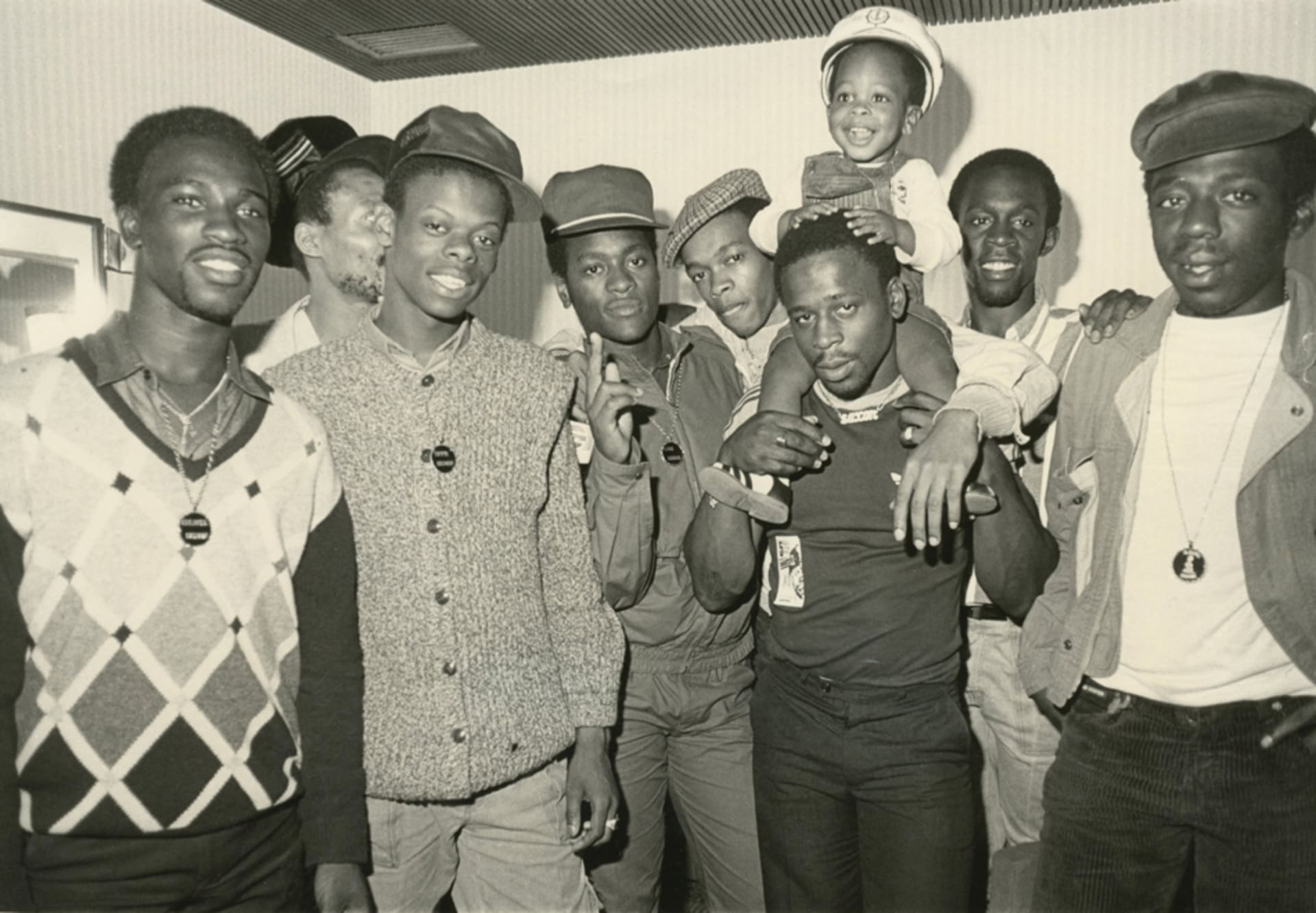
Photo from:

Without The Windrush Generation, British MC Culture Would Be Non-Existent

Excerpt from:

William ‘Lez’ Henry (2012) Reggae, Rasta and the Role of the Deejay
in the Black British Experience, Contemporary British History, 26:3, 355-373,
DOI:10.1080/13619462.2012.703024

On sound and fear

Sound is often understood as generally having a privileged role in the production and modulation of fear, activating instinctive responses, triggering an evolutionary functional nervousness.
The power of sound to instill dread was well known to the heavily outnumbered Maroons, the tribal nation turned guerrilla fighters who claimed a number of astounding victories in their asymmetric conflict with the English colonialists in Jamaica during the
late eighteenth century.
The abeng, a fashioned cow horn, had two uses: by slave holders to call the slaves to the cane fields and a “traditional form of communication among the communities, warning them and sending messages across difficult terrain.”

The Maroons used the  abeng in tandem with their other special techniques—drum communication, the ambush, and camouflage—in order to outwit the British: “They embedded themselves in leaves and vines and melted into the surrounding bushes. The
British repeatedly walked into clearings where their surroundings would suddenly come
alive and close in on them.”

The abeng, as a system of communication, produced signals “reproducing the pitch and rhythmic patterns of a fairly small vocabulary of Twi words, from their mother language, in most cases called Kromantin (Maroon spelling) after the Ghanaian port from which many slave ancestors were shipped.”

Sentries stationed outside the villages would  use the different pitches to communicate the British approach, the extent of the weapons they carried, and their path. But the abeng also had another affective function: to scare the British with its “hideous and terrible” dislocated tones, sometimes managing to repel the invaders with sound itself. Gradually, as the British learned to assign a cause to its shrieking, high- pitched sound, their terror of Maroon ambush only intensified.

Found in 1738: Bad Vibrations, from:
SONIC WARFARE Sound, Affect, and the Ecology of Fear, by Steve Goodman.
Massachusetts Institute of Technology. 2010.

ON BABYLON AS ANANCY REGIMES

Rastafarians apply the theory of Babylon to Jamaican society as well as to the rest of the world. In Jamaica Babylon encompasses the concerted efforts of various agencies representing the power structure, those who have a stronghold on available resources. One of the most important characteristics of this group is that it excessively emulates Western culture. The culture of the oppressed, consequently, is relegated to a second-class status. Western culture is seen as the measuring rod to demarcate that which is superior. Babylon in this sense entails “part of a world view and cultural perceptions” which degrades anything African. Transcending such perceptions, the Rastafari idealize Africa.
The Rastafarian critique of Babylon transcends Jamaican society and includes denouncing capitalistic systems as well as certain communistic regimes.
Rastafarians refer to these systems as “anancy regimes”, oppressive systems based on shrewdness. International Babylon is represented by the industrialized nations of the world, spearheaded by the United States, as well as key religious institutions such as the Vatican. According to the Rastafari, international Babylon has a long history with a succession of oppressive eras. They note that oppressive regimes such as those of the Persians, Greeks, Romans, British, and Americans have dominated world history. From the Rastafarian perspective, all of these regimes were inspired by the activities of “Nebuchadnezzar, the infamous king of the Biblical Babylon“. It is within this
overall historical context that the Rastafarians explain their experience and ultimate mission, the overcoming of the oppression of Blacks and humanity at large.

From:

Social Movement Endurance: Collective Identity and the Rastafari 

by  Alem Seghed Kebede, Thomas E. Shriver, J. David Knottnerus.

in  Sociological Inquiry, Vol. 70, No. 3, Summer 2000, 313-37