
#cannabis

Jah Billah says:
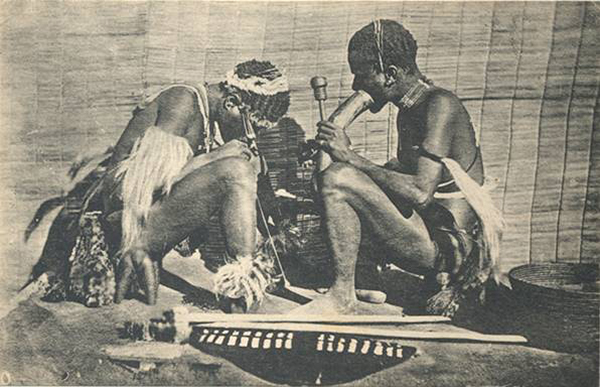
This article delineates pre-colonial and colonial use of cannabis in Africa. Starting with prehistoric cultivation 1300 BC in Ancient Egypt, and 2000 years ago in Madagascar. Going over North African and Sub-Saharan cannabis cultures, we learn that cannabis use was associated with coffee and that in Ethiopian language plant was once called esha tenbit “prophecy plant”. But what we choose to highlight here is documented use of tobacco as a colonial weapon against African cannabis cultures:
Cannabis Commerce and Legality
African cannabis markets were earliest documented in 13th-century Egypt, and 17th-century Southern Africa. Europeans widely observed commercial and exchange markets in all continental regions during the 1800s and early 1900s. In the Maghreb, 19th-century markets were highly formalized. By 1870, governments in precolonial Morocco and Ottoman Tunisia both began selling annual monopolies to their cannabis (and tobacco) trades. These monopolies continued under French rule until 1954.
European-controlled trades arose within colonial contexts and mostly supplied hard laborers. Three major trade regions existed, including the Maghreb. In South Africa, European merchants and settlers farmed and traded in cannabis from the late 1600s into the 1900s. Portuguese Mozambique also supplied South African laborers via exports to British Transvaal between 1908 and 1913. Miners were prominent consumers in colonial Southern and Central Africa. Finally, cannabis trades in western Central Africa included local traders stocking locally grown cannabis, as well as formal exports from Portuguese Angola to São Tome and Gabon during the 1870s to 1900s.
Even as these trades developed, colonial regimes increasingly suppressed cannabis. Rarely, colonial laws
rose upon indigenous prohibitions, as in Madagascar, where Merina royalty forbade cannabis by 1870,
decades before the French. Colonialists considered African cannabis an Eastern hindrance to Europe’s
civilizing mission. “The tobacco introduced by the Portuguese has contended successfully against the stupefying or maddening hemp […] from the far Muhammadan north-east,” told a British administrator in Belgian Congo in 1908.

Cannabis-control laws were enacted in Africa generally earlier than elsewhere worldwide, and were stricter too. Initial laws mostly aimed to improve public health, primarily by prohibiting behaviors considered detrimental to “native” health. Many laws clearly served ulterior motives, particularly labor control and religious proselytizing. British Natal’s 1870 law aimed to control Indian laborers, while Portuguese Angola’s 1913 law targeted colonial troops while also pushing farmers toward tobacco production. Cannabis was banned in most colonies by 1920. The plant drug first appeared in an international drug-control convention in 1925, based on the request of South Africa’s white minority government supported by newly independent Egypt, whose conservative authorities had suppressed cannabis since 1868 to control laborers.
Colonial authorities accepted and encouraged some drug crops—particularly tobacco, tea, and coffee—but cannabis was excluded, despite the existence (around 1840–1940) of an international market for Western pharmaceutical preparations of cannabis, supplied primarily from British India.
From:
Cannabis and Tobacco in Precolonial and Colonial Africa
Chris S. Duvall, 2017.
https://doi.org/10.1093/acrefore/9780190277734.013.44
 OUT OF MANY COME DUB AND OUT OF DUB COME ONE