

#rasta #style #Cuba
Real versus fake Rastas
Not unlike in many other Rasta communities around the world some of the more conservative religious brethren have introduced a view and language of authenticity with regards to what it means to be a Rasta. Framed in a discourse of cultural purity, they speak of so-called "real" and "unreal or “fake" Rastas. But, given the myriad of ways people in Cuba identify with and express Rastafari, who can be considered a “real” Rasta?
The aim of my research has precisely been to go beyond fixed ideas of what constitutes a Rasta and instead look at how and why people define themselves as such and what processes go into making that
identity. Apart from this all-inclusive approach, the movement’s own fragmented entrance into Cuba and the many ways in which it has been appropriated have led to the wide array of definitions and expressions of the movement.
Although I have grouped certain main characteristics together and created certain "types" of Rastas for analytical purposes, in actuality every individual has his/her own idiosyncratic understanding and way of manifesting Rastafari. Ulf Hannerz’s views on the social organisation of culture are particularly helpful in understanding Rastafari’s heterogeneous character in Cuba: The social organisation of culture always depends both on the communicative flow and on the differentiation of experiences and interests in society. In the complex society, the latter differentiation is by definition considerable. It also tends to have a more uneven communicative flow - that is, different messages reach different people. The combined effect of both the uneven flow of communications and the diversity of experiences and interests is a differentiation of perspectives among the members of the society.
Rastafari in Cuba has been localised in just such a fashion. In an almost consumer-like attitude towards culture, individuals have selectively chosen, imitated and modified Rasta elements as well as mixed and matched them with other cultural practices. Whilst some have thus consciously hybridised different cultural elements together, others have kept them consciously apart by way of “cultural crossing” or “milieu-moving". Others yet again have adopted what Swidler (1986) has referred to as a “toolkit” attitude towards culture, in which people engage in their everyday activities by “selecting certain cultural elements (both such tacit culture as attitudes and styles and, sometimes, such explicit cultural materials as rituals and beliefs) and investing them with particular meanings in concrete life circumstances“.
In illustrating their skills at maintaining, mixing and serially selecting facets of different lifeways and styles all Rastas have demonstrated a high degree of multiple cultural competence as well as an attachment to a multiplicity of identities. In addition, all Cuban Rastas, even those who insist on an ideology of purity, have to a greater or lesser extent juxtaposed and fused objects, symbols and signifying practices from different and separate domains and in so doing have produced new, creolised versions of Rastafari.
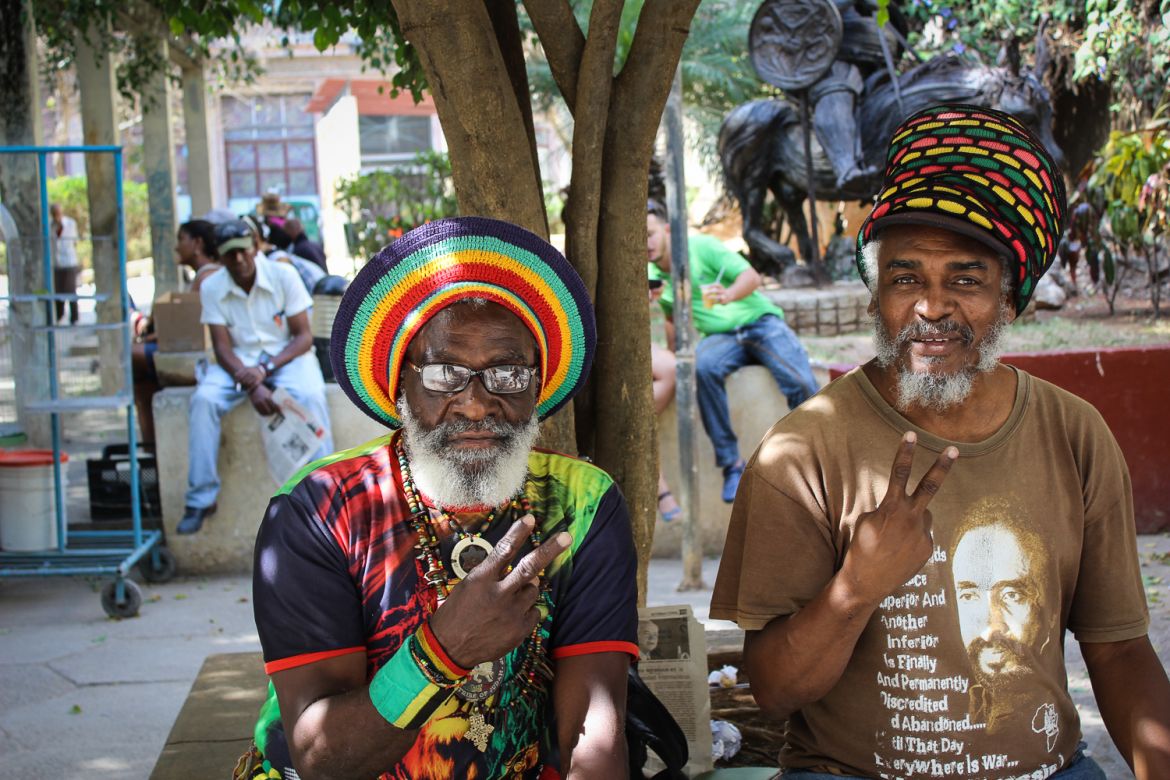
On the whole, what we thus find is a wide variety of identifications with the movement, which can perhaps best be described as a Rasta continuum, ranging from orthodox religious brethren and sistren to those who identify with Rasta as a style. This same continuum is in addition in constant flux as individuals engage in an ongoing process of learning, adding, copying and reinterpreting Rastafari symbols and doctrine. As a cultural phenomenon Rastafari can be said to be in a constant state of cubanisation.
Chapter from:
Katrin Hansing (2001) Rasta, race and revolution: Transnational
connections in socialist Cuba, Journal of Ethnic and Migration Studies, 27:4, 733-747,
DOI:10.1080/13691830120090476
 OUT OF MANY COME DUB AND OUT OF DUB COME ONE