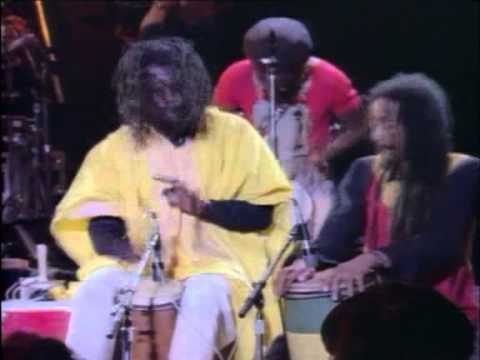
On Rastafari branch and roots

Peter Tosh – Live @ The Greek Theater, Los Angeles, CA, – August 23.1983


By 1960, several Jamaican institutions had begun to show an interest in the counterculture, and to contribute to the demarginalisation of the Rastafari movement which had previously been repressed.
One such institution was the University of the West Indies, which put the Rastafari on its agenda.
In the course of these trajectories, Jamaican public opinion, which had predominantly perceived the Rastafari movement to be a crowd of violent criminals, fools and outcasts, changed successfully.

Particularly, reggae music (as the emancipation of Jamaican popular music) was co-opted.
The result of the blending of Afro-Jamaican Burru and Kumina drum techniques and folk traditions with Afro-American musical styles (including jazz, gospel, rhythm and blues, soul and swing) led to the creation of mento, ska, rocksteady and reggae styles like dancehall, dub, lovers, raggamuffin, rockers and roots, which ‘exerted a tremendous influence on the development of post- World War II popular music globally’.
The musical film The harder they come (1972), starring Jimmy Cliff, contributed enormously to the transnationalisation, popularisation and commercialisation of roots reggae. Not until this style developed, did reggae lyrics exhibit the spirituality and socio-political engagement that came to be seen as the hallmark of roots reggae. And, clearly no one represented the Rastafari rhetoric and feelings of this genre to the world more ably and persuasively than Bob Marley.
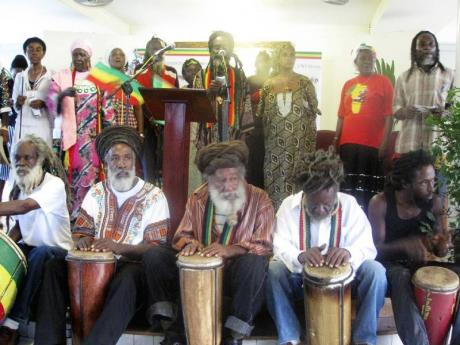
Augier urges Rastafari to accept Jamaica as home


In fact, conscious reggae music, with its recreational, critical and inspirational dimensions, would soon transcend the Rastafari milieu and succeed in conquering a global audience. Today, Rastafari not only has observer status in the United Nations, but even more importantly it has become part of everyday culture in Jamaica, and even abroad.
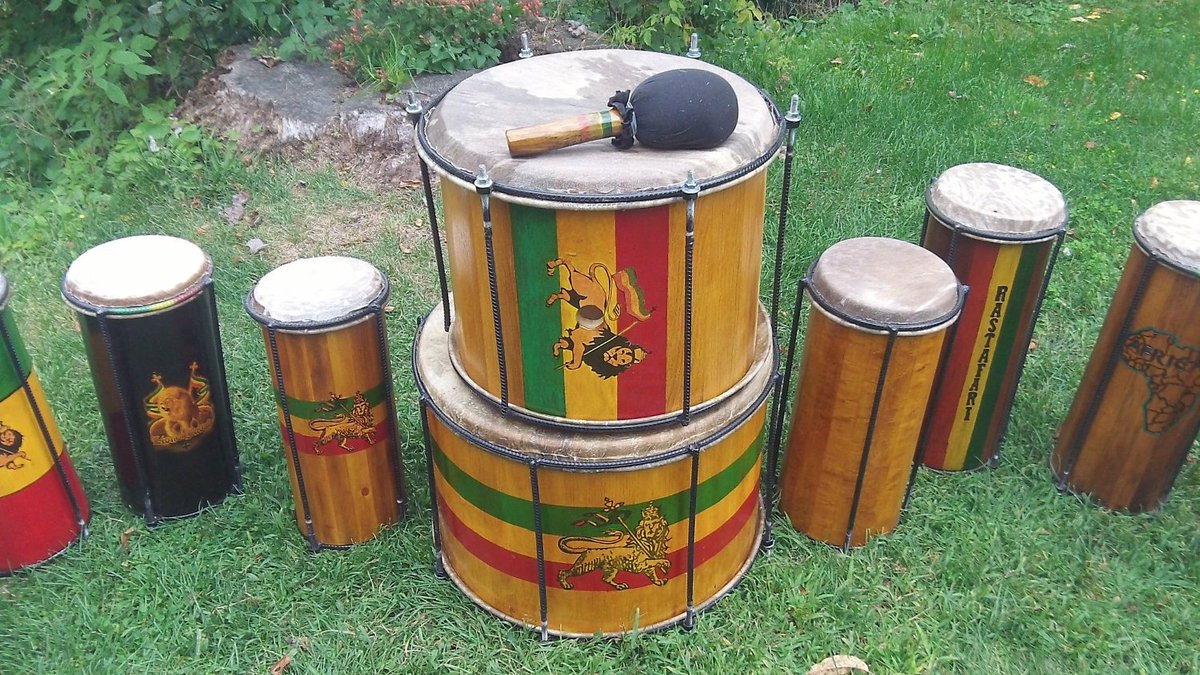
However, the various Rastafari mansions relate differently to reggae music: whereas Boboshanti reject reggae as part of their culture and only consider drumming and chanting as true Rastafari music, the Theocracy Reign Order of the Nyahbinghi describes its relationship to reggae through the metaphor:

‘Reggae is the branch, Nyahbinghi is the root.’


Text from:
The global–local nexus: popular music studies and the case of Rastafari culture in West Africa
Frank Wittmann, 2011.
Critical Arts: South-North Cultural and Media Studies


On the many faces of Rasta: Nyabinghi Order

Michael Barnett in his 2005 essay “The many faces of Rasta: Doctrinal Diversity within the Rastafari Movement” gives description of main branches of Rastafari: Twelve tribes of Israel, BoboShante and Nyabinghi Order.
First part of the chapter on Nyabinghi Order also goes into the origins of Rastafari dreadlocks:

The Nyahbinghi Order

This Mansion is the oldest of the previously mentioned in that it has its roots strongly connected to those of the vintage Rastafari.

The Nyahbinghi order is generally regarded as the most orthodox mansion within the broader Rasta movement and is variously known as the House of Nyabinghi, Theocracy Reign Ancient Order of Nyahbinghi, the Theocratic Government of Rastafari, Haile Selassie I, and even the Theocratic assembly.

The term Nyahbinghi according to Campbell came from the anti -colonialist movement of Kigezi in Uganda which called for death to Black and white oppressors.

The University of the West Indies Report, details that on the 7th December 1935 the Jamaica Times published an account of the Nyahbinghi Order in Ethiopia and the Congo.
According to this account in the Times, the Ethiopian Emperor was head of the Nyahbinghi Order, the purpose of which was to overthrow the white (Italian) domination of Ethiopia, by racial war.

According to the University Report the term Nyahbingi came to mean in Jamaica, for many Rastafari, death to Black and white oppressors.
Those who were in accord with this ideology quickly adopted the title, Nyah-men (alternatively spelt as Niyamen).

What is clear from the University Report is that Leonard Howell’s followers at Pinnacle were perceived by the researchers to be the most prone to violence of all the Rastas in Jamaica; they further argue that from 1933 Howell had been preaching violence, thus they surmise that it was mainly Howell’s followers who adopted the name, Nyahmen, and who appropriated a countenance that was consistent with the name.

Howell’s followers are also credited by the University Report to have been the first dreadlocked Rastamen (locksmen) in the history of the
movement, appearing on the scene with the second installation of the Pinnacle camp in 1943.
However, according to Chevannes , the first dreadlocked Rastamen were those of the Youth Black Faith movement, who took on this appearance in about 1 947. In weighing both accounts this researcher proposes that there is validity in both, on the basis that it is highly possible that both the Youth Black faith Movement and the Howellites were inspired by the Mau Mau who spearheaded the revolt against the British colonial powers in Kenya.
This perspective takes into account that much of the early history of Rastafari is derived from oral testimonies and is thus subject to distortion, as Chevannes so astutely points out.


However, while Ras Boanerges (Bongo Wato), one of the founders of the Youth Black Faith has given testimony that his organization was the first to start wearing dreadlocks, this writer feels that there are too many accounts of Howellites who used to stand guard over the second installation of the pinnacle camp, having dreadlocks, to be discounted.
What we do know is that by the early 1950s the wearing of dreadlocks starts to become visible among the Jamaican Rastafarian community and this very noticeably coincides with the prominence of
the Mau Mau in Kenya.

Was this merely a coincidence?


From:

The many faces of Rasta: Doctrinal Diversity within the Rastafari Movement
By: Michael Barnett
Source: Caribbean Quarterly, Vol. 51, No. 2 (June 2005)