On online collaborations

#HajiMike

Snyclavier II

Writing music online is nothing new. In 1994 ResRocket was the first online ‘band’ project with over 1,000 participants who exchanged ideas and files via a mailing list and ftp server.
By 1999 this had developed into one of the first live online music collaborations, screened on BBC TV in front of 55 million viewers. Bob Marley’s ‘Them Belly Full (but we hungry)’ was recorded live involving Sinead O’Connor, and Brinsley Forde in London, Thomas Dolby in San Francisco and Lucky Dube in South Africa.
While this marked a radical change in online music production it would take another few years before such creative collaborations would have more mass appeal from a production standpoint.

An obvious change came in radical developments in music production itself. The advent of more accessible and affordable Digital Audio Workstations (DAWs) which evolved from early pricey microprocessor based non-analogue tapeless systems, such as the Synclavier and Fairlight CMI to software such as DigiDesign’s Pro Tools, Logic Audio and Cubase ( the latter via the earlier pioneering Atari ST). Digitisation in more recent years has resulted in even cheaper or freeware options.
A PreSonus soundcard for example comes with a free version of the company’s own DAW software called Studio One (Presonus, 2010). Reaper from Cockos calls itself ‘Audio Production without limits’ and while it can be purchased the free evaluation copy functions in exactly the same manner (Reaper, 2010).

Simultaneously, The Internet itself has changed dramatically in terms of bandwidth, speed and accessibility. We have moved from archaic (by today’s standards) brick sized modems for the few who knew how to use binary computer code in the mid-1980’s to more compact modems with increased bandwidth and more recently DSL and fibre optic connections. Ten years ago it was possible to send a wav or aiff file online, it may have taken a few hours but now, it is much faster and easier, taking perhaps 10-15 minutes for say a 54 megabyte wav file. This is usually done through file transfer web sites such as ‘Sendspace’ and ‘Yousendit’. Many musicians now work together through their own ftp sites accessible with a username and password through their own web sites.

These advances have made a-synchronous music collaboration much more accessible to more people online in different locations around the world.

Fully synchronised collaboration exists as well, although this is usually subscriber based with a fee and requires substantial outbound bandwidth, often not accessible to as many people.

Examples of this include RiffWorks ( http://www.riffworld.com/) and NinJamm (http://ninjam.com/) although at times there are latency issues with both.

So although it is possible to link up studios in real time by using a service such as ‘source direct’ or an Avid Satellite link the cost of these options would be substantially high.
Synchronised music production online in different studios is still an emerging form of technology at least in terms of mass usage. It is likely, given rapid changes in technology that this may change through existing online communication tools, such as say Skype.

It is tempting at this point to view all these developments simply from a technologically deterministic standpoint, a view which one often finds in professional music production magazines which can be interpreted like a bunch of reviews on products, software and releases which exist in a kind of non-social world. I find such approaches based on technological determinism to be flawed from the outset as for me it is more important to understand how we can utilise various tools to create and make music through social engagement. The bottom line is not so much how the tools use us but how we use the tools and how these changes have had a sociological impact in interactive creative processes from symbolic and symbiotic points of view.

We have moved from a ‘sit-back-and-be-told culture’ to a ‘making-and-doing culture’. There are many social media web sites now which allow us to upload, share and exchange music, such as FaceBook, YouTube, Twitter, ReverbNation, Myspace, Soundcloud and Soundclick to name just a few. More niche oriented social media sites and web portals that specialize in particular forms of music and music scenes also exist. So people work within specific genres and across them. For example, Dubstep, The Dub Scrolls, BeatPort, and HipHop Makers. Through such sites, generic and niche, I found myself working online with people in Greece, Malta, Portugal, Sweden, UK, USA, and Cyprus.

The main reasons why I engaged in online musical collaboration was partly a frustration I had with studio based work, particularly being a spoken word based artist based in Cyprus making reggae, where many local studios and producers lack experience in these genres. I also entered into online collaborations by being approached by various people, who were more grounded in the kinds of music I engage in, to work with them online.

What appealed most to me was the openness of the Internet and the fact that it allowed users to explore so many different avenues in an accessible and democratic manner. Immediacy was also a major bonus. A song as I found out could be created, recorded, edited, mixed and mastered in different
places in say 24 hours. Additionally, various aspects of music production, distribution, promotion, and management became demystified. It became that much easier to make and share music with specific audiences via free social media web sites.
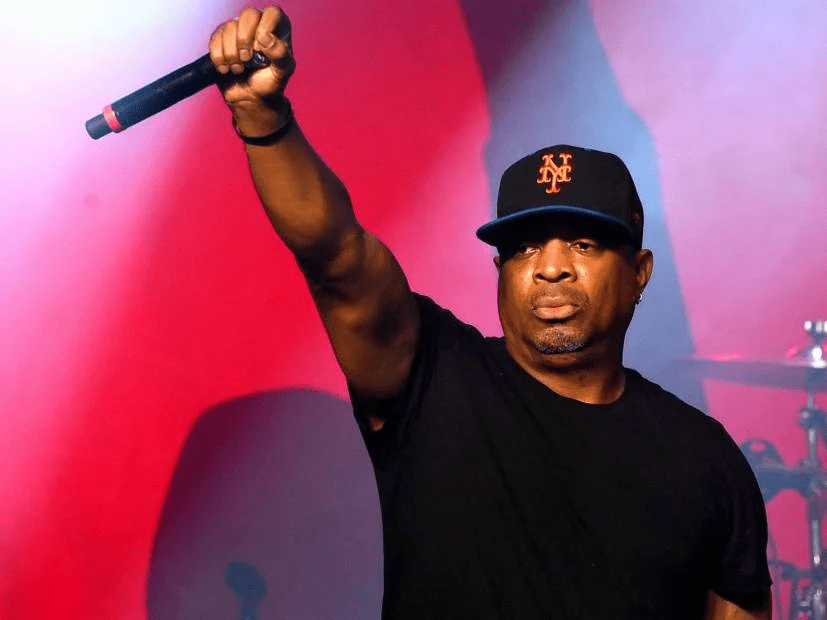
Chuck D from Public Enemy


So independent net based labels, which Chuck D from Public Enemy dubbed as ‘Winties’ (web based independent labels) sprouted up in many countries around the world. The traditional filtering role played by radio and TV in the music industry in some ways became obsolete, after all much of the time they played only material that was signed to major labels and artists that had spent substantial amounts of money on their video clips. Now it is much easier to set up say a myspace account, upload some songs, live band footage, and gets known. Guerilla music making and self-marketing techniques are nothing new. They were deeply embedded in so many popular music scenes from punk rock to reggae. But the Internet suddenly gave that much more power to musicians to simply make, share and raise awareness of their existence. It is for example pointless and many people could also argue that it was from time, to send hundreds of cassettes or CD’s or vinyl demos out to record companies for consideration. Now an electronic press kit (EPK) could be assembled for free and sent to hundreds of targeted people with the click of a mouse.

Parts from Background – The Revolution has many interfaces! found in

Virtual Oasisthoughts and experiences about online based music production and collaborative writing techniques

By Mike Hajimichael aka Haji Mike, 2010.

On co-opting Reggae and Rastafari revolution

Jah Billah intro:
This text highlights tactics used by Babylon to regain social control over revolutionary social movements.
In escalating progression these appear as:

Evasion – ignoring
Counterpersuasion– ridicule and linguistic control
Coercion or Coercive persuasion – violence
Adjustment – co-opting the social movement
Capitulation – Babylon take over

Even if take just a quick look at first tactic “creating dead channels” we can witness how online media surrounds us with fake activist influencers who do the talk yet never remember to do the walk.

CIA, Guns, and Rasta: Inside the Making of Reggae’s Most Iconic Film

The Rhetoric of Social Control 

Responding to the agitation of a social movement, ‘‘establishments’’ tend to Resort first to ‘‘evasion,’’ which involves, in effect, pretending that the social movement ‘‘does not exist or that it is too insignificant to recognize’’.
Establishments can postpone action, appear constrained to grant protest goals, control or change the social or political agenda , lie and control information, deny protestors the physical means of protest, deny protestors access to the media, and create ‘‘dead-­‐end’’ channels of influence.
For example, during the 1960s, several poor, Black communities in Baltimore waged a war on poverty, challenging the dominant White majority who controlled the city’s political structure.
In order to thwart the demands of the protestors, Baltimore’s political establishment employed a standard evasion tactic, changing the political agenda. The protestors insisted that the city government must invest the necessary time and resources to address Baltimore’s impoverished areas. In response, Baltimore’s political establishment changed the political agenda to ‘‘improve the absolute well-­‐being of the city’s entire population, not to effect a redistribution of values in favor of the poverty-­‐stricken blacks’’.

The second strategy is called ‘‘counterpersuasion.’’
In counterpersuasion, governments and their surrogates seek to discredit movement leaders or to show their ideas are ‘‘ill-­‐advised and lack merit’’.
Counterpersuasion may be part of a larger rhetorical matrix called ‘‘administrative rhetoric,’’ or the establishment’s attempt to undermine a social movement’s ideas and influence.
A number of counterpersuasion tactics have been identified, including ridicule, discrediting protest leaders and organizations, appealing to unity by ‘‘crying anarchy’’, and linguistic control.
In a study on the Equal Rights Association, Martha Solomon ( 1978) argued that the STOP-­‐ERA political campaign employed the tactic of ridicule to paint ‘‘an unappealing picture of the feminists’ physical appearance and nature’’.
Portrayed in ‘‘devil’’ terms, ERA supporters were labeled ‘‘anti-­‐male,’’ ‘‘arrogant,’’ and ‘‘abortive.’’ In contrast, ERA opponents were characterized within the ideological framework of the ‘‘Positive Woman’’—physically attractive, intelligent, and emotionally fulfilled.

When milder strategies prove unsuccessful in counteracting the agitation of a social movement, establishments typically resort to a strategy of ‘‘coercion.’’
This strategy may remain largely rhetorical, what Stewart, Smith, and Denton refer to as ‘‘coercive persuasion’’. Simons ( 1972, 1976) coined the term ‘‘coercive persuasion’’ because he believed ‘‘elements of persuasion and inducement or persuasion and constraint are generally manifested in the same act’’.
For example, police officers combine physical and verbal intimidation to control deviance before a social disturbance breaks out.

If ‘‘coercion persuasion’’ fails, the conflict can escalate to more physical tactics, such as restrictive legislation, physically attacking demonstrators, firebombing homes, imprisonment, or even assassination.
Oberschall ( 1973) observed that during this conflictual stage ‘‘the authorities seek to destroy the organization of the opposition, arrest their leaders, and even set up stooges that allegedly speak for the population from which the protestors are drawn’’. In a comprehensive study of how riot commissions interpret and investigate riots, Platt ( 1971) reported that an estimated 34 people died and over 4,000 were arrested during the 1965 Watts riots. According to Platt, a jury later discovered that the Los Angeles Police Department and the National Guard were responsible for 23 of the 26 ‘‘justified’’ murders.

When all strategies have failed, an establishment may employ the ‘‘adjustment’’ strategy, which ‘‘involves making some concessions to a social movement while not accepting the movement’s demands or goals’’ .
Adjustment tactics can encompass ‘‘symbolic’’ concessions, such as Manley’s public praise of the Rastafarian movement, or establishments might sacrifice some of their own personnel if a ‘‘social movement focuses its agitation and hatred upon a single individual or unit’’.
Elites can use economic rewards to satisfy and stratify a protest group or establish committees to investigate issues.
If a social movement’s agitation becomes especially intense, the establishment might even incorporate movement leaders and sympathizers into the establishment by appointing them to low-­‐level decision-­‐ making positions.
Or the establishment might incorporate parts of the dissent ideology into the mainstream, entering into a loose confederation with the social movement.

Yet, cooperation with a dissent group ‘‘may lead to outright co-­‐optation of the cause’’ or a literal takeover of the movement by elements of the mainstream establishment. Gamson ( 1968) suggested that establishments use the co-­‐optation strategy when prior control strategies were unsuccessful.
Social movements that are co-­‐opted are often ‘‘subject to the rewards and punishments that the organization bestows’’. In fact, according to Gamson, ‘‘new rewards lie ahead if they show themselves to be amenable to some degree of control’’.

The final strategy, capitulation, occurs when the social movement’s ideas, policies, and personnel ‘‘replace those of the target institution’’.
In the case of the Rastafarian movement, the Jamaican government did not capitulate to the demands of the Rastafarian movement. Instead, the Jamaican government and its supporters co-­‐opted the cultural symbols of Rastafari and reggae music as authentic reflections of Jamaican society.


Text from:
The Co-optation of a ‘‘Revolution’’: Rastafari, Reggae, and the Rhetoric of Social Control
Author:
King, Stephen A. (1999).
Faculty Research and Creative Activity. 15.
http://thekeep.eiu.edu/commstudies_fac/15

The Mighty Ginsu ft. The DJ Dont Stop – Souljahs Rebel

Outside of generic riddims and sound trends here comes project exciting with revolutionary  reality and consciousness, so best check out “Time Is the Key” album.

CELT ISLAM MEETS MASALA – REVOLUTION INSIDE US

DUB IS REVOLUTION THAT IS BEYOND DEMANDS

DUB IS REVOLUTION

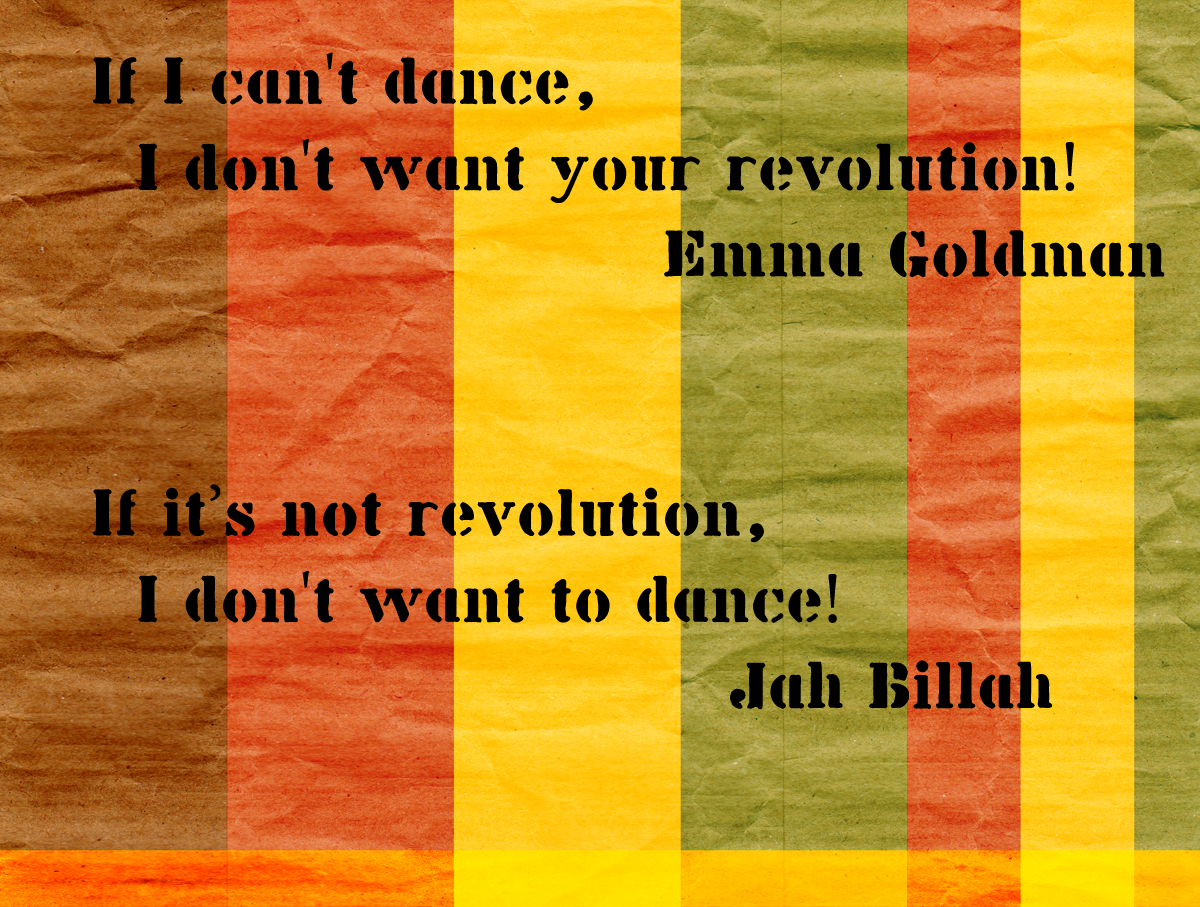
IF IT’S NOT REVOLUTION, I DON’T WANT TO DANCE!

DANCE