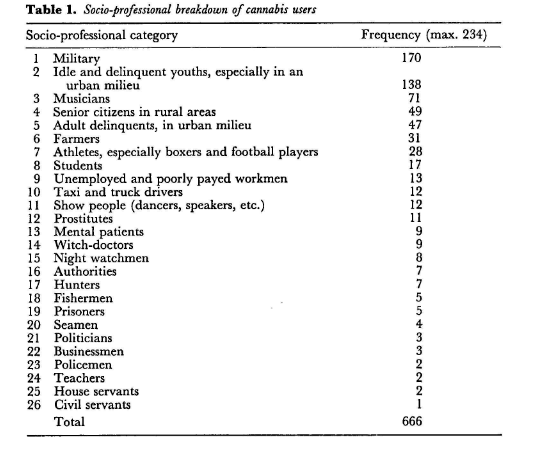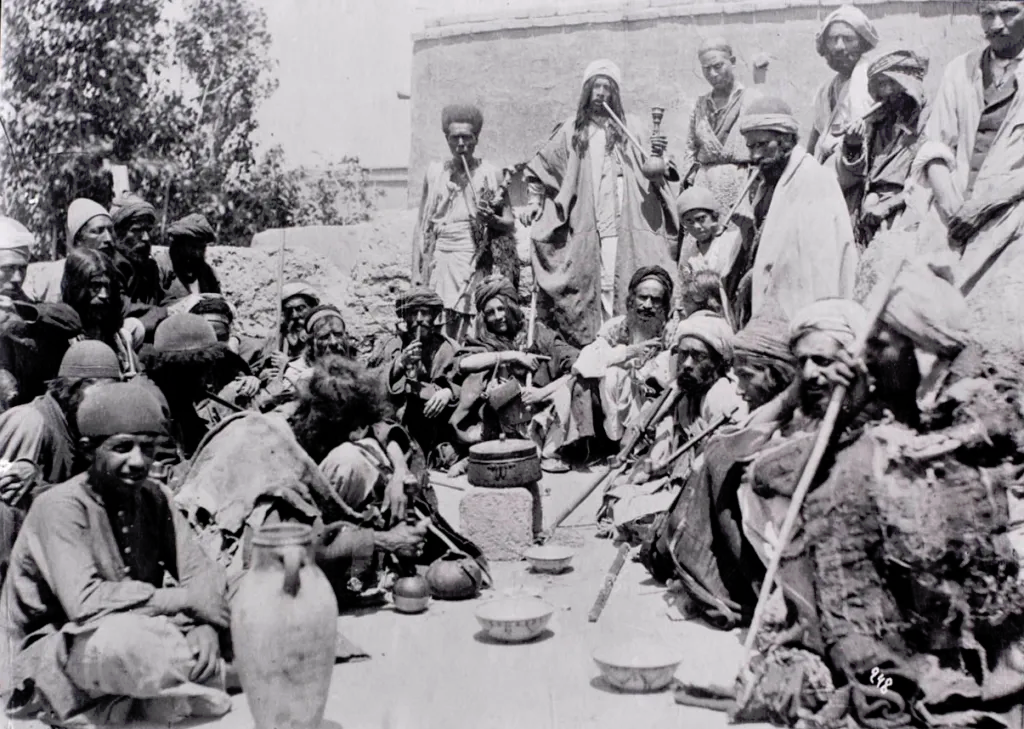
The Use of Indian Hemp in Zaire: A Formulation of Hypotheses on the Basis of an Inquiry Using a Written Questionnaire Ronald Verbeke and Ellen Corin Br. J. Addict., 1976, Vol. 71, Longman. Printed in Great Britain.
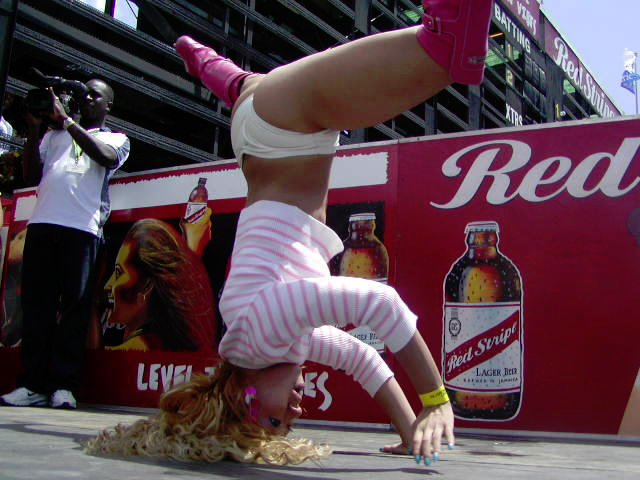
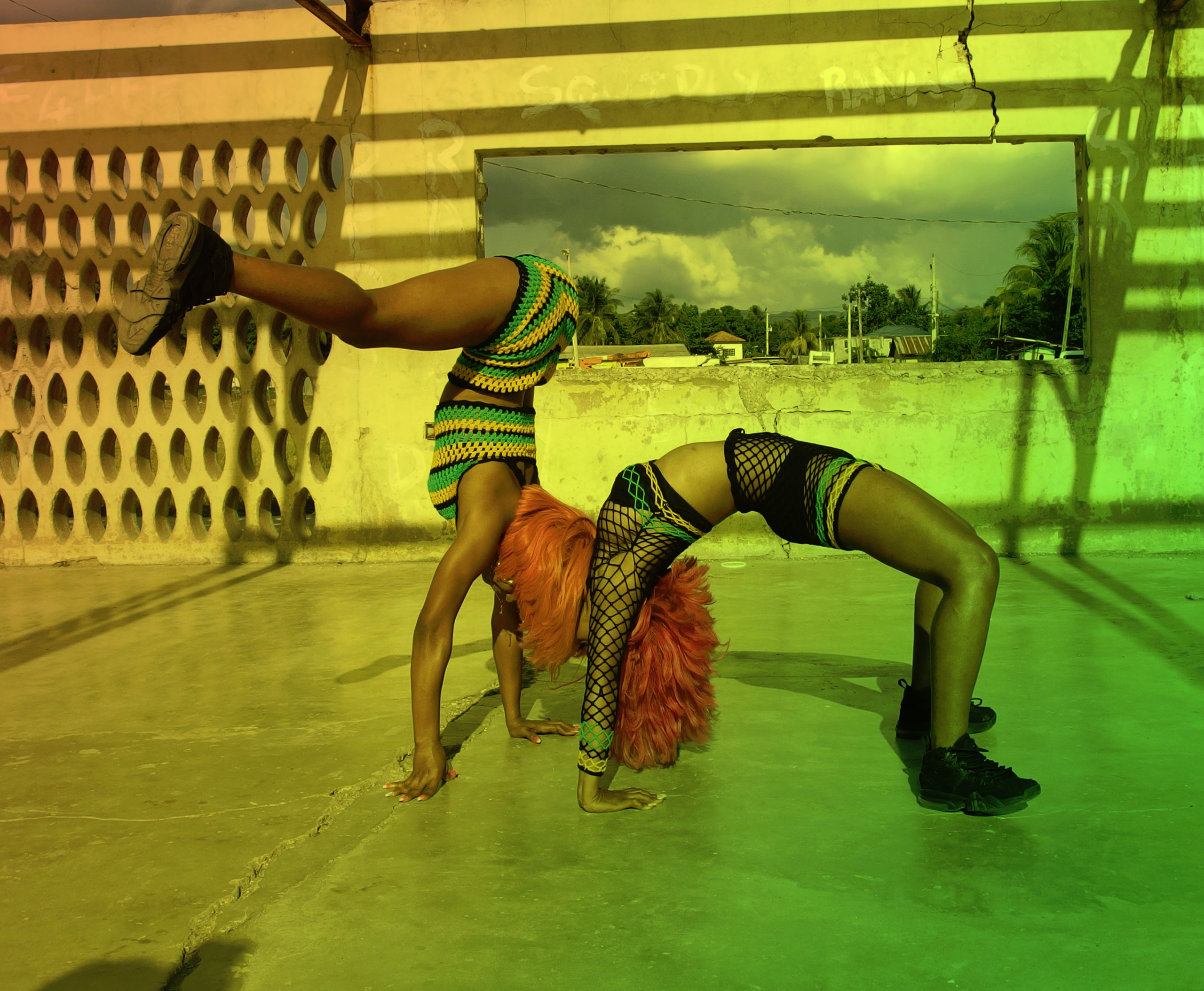
Key participants consistently create, or transcend boundaries, notably, in the form of categories, spaces and material reality. The phenomenon of Dancehall queen is a crucial example. Dancehall queens emerged as informal community celebrities and have existed since the 1970s. Since Poochiloo and other less acknowledged queens of the Dancehall, Carlene Smith (the 1992 media proclaimed queen) in particular, and Stacey (crowned queen in 1999), have ushered in a new era in Dancehall: the rise of image, style, appeal, and a ‘narrative of queen’.
However, this was an old phenomenon that featured in such traditional forms (both secular and religious) as Kumina, a Congo-derived Afro-Jamaican religion (with Mrs Imogene ‘Queenie’ Kennedy as the most popular), Jonkonnu, Bruckins Party and Queen Party.
This is paralleled by the ‘Mother’ or chief spiritual arbiter in Revival and Burru’s ‘Mother Lundy’. Additionally, there are Carnivals in the wider Caribbean (and its diaspora) where carnival queens are crowned based on authenticity, appropriate movements, mannerisms and dress. The ways in which the presence of ‘queen’ within both secular and religious settings mimics the status and symbol of great African queens, especially queen mothers of the Akan tradition such as Yaa Asantewa, Queen Mother of Ejisu whose war against the British is a well-known fact of West African history,
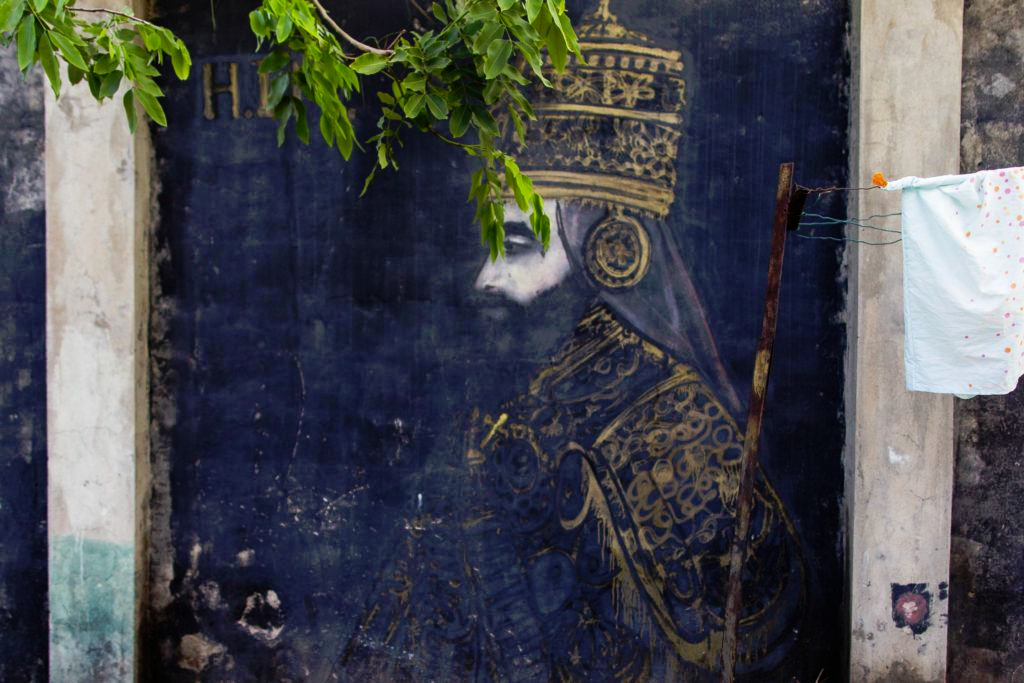
Ras Tafari’s Empress Menen, as well as the colonial legacy of the British Queen, is noteworthy.
The idea of ‘queen’ as a category, once simplified, reveals the consistently elevated place of woman as a key counterpart of the male ‘king’, in both the popular and religious realms. In this sense, within the Diaspora, the pervasiveness of a central female persona is consistent with African popular and sacred traditions as well as the kinship patterns that are matrilineal and/or matriarchal in character. …
For the dancer and the queen in particular, Dancehall is a stage, a status granting institution outside the socially constricting everyday, a space to emerge and maintain stardom on the basis of physical attributes and/or ability. It is also platform through which women define the terms and conditions of success, style, contest, while creating place and space for other women beyond constricting social conditions.
Text source:
Sonjah Stanley Niaah (2004) Making space: Kingston’s Dancehall culture and its philosophy of ‘boundarylessness’ , African Identities, 2:2
Because of its significance to social action and relations, space is theoretical tool in understanding power. Much power is spatialized, as the use and control of space are continuously negotiated. Those in power specifically, the state attempt to maintain their position through division and control of space, what Foucault calls spatial ‘techniques’ of domination: maps, censuses, quarantines, surveillance; all facilitate control through the segmentation of space and separation of groups or individuals by those in positions to produce knowledge.
Part of the power in space lies in the possibility of creating and maintaining difference and hierarchy through it. The most practical Marxist example is the skewed distribution of resources through space and the associated uneven development, but difference is also created symbolically through the naming and ‘knowing’ of spaces: the differentiation between ‘good’ and ‘bad’ neighbourhoods, ‘developed’ and ‘developing’ nations. Factories, prisons, public housing projects, gated communities, shopping malls and coffee shops are all examples of urban spaces through which social difference is constructed and sometimes challenged. ‘Othering’, then, is also done by delineating belonging and otherness in spatial terms: place of birth, area of residence, workplace, spaces of leisure and consumption. In the process, meaning is created not just in but through space. …
Music is a spatial phenomenon, as it is tied to specific places, is implicated in how sites or spaces are perceived, and is intimately connected to the travel of people, goods and ideas through space. Music and musical cultures are integral in shaping discursive, textual spaces or spatial narratives that are not necessarily pinned to one physical location but rather can be applied to various ‘real’ material sites, giving meaning to a range of spatial experiences and practices. Part of this discursive spacemaking involves narrating new contexts for struggle or contestation.
Gibson, for instance, discusses Aboriginal popular music in Australia and how the musicians are involved in the construction of differently scaled ‘arenas of empowerment’ that offer space for indigenous self-determination. The production and consumption of music take place in specific spaces that gain meaning through these locations, just as they imbue the music itself with meaning. Stanley Niaah shows how the dancehall in Jamaica, with its inner-city core, is a liminal space, both marginal and central, in which celebration, conflict and memory are musically inscribed. The spatial importance of music is also evident in crossing global distances and divides, more easily even than visual or purely textual media, connecting like-minded groups across the globe by forming what Carolyn Cooper, after the poet Kamau Brathwaite, calls
‘bridges of sound’.
Found in chapter Music, space and power from:
Surinamese Maroons as reggae artistes: music, marginality and urban space By Rivke Jaffe and Jolien Sanderse, 2009.
Ethnic and Racial Studies Vol. 33 No. 9 October 2010
Reggae is a key expression of the Rastafarian inner landscape. As a product which stands on its own merit, reggae is often conceived as divorced from the core Rastafari space and purpose. However, Nettleford reminded us that reggae exists because of Rastafari. He stated:
I keep telling people that reggae or ska right through to dancehall appropriated the Rastafarian movement, not the other way around. People don’t understand this; that in fact reggae has taken to itself an ontology, a way of being, a cosmology, a way of thinking about the world, and an epistemology – a way of knowing, getting to know things – through the Rastafarian movement . . . Mr Marley . . . decided that he had to employ not only the outward signs but also the inward grace of the movement. The inner landscape is very much dependent on the belief, faith of the Rastafarian movement . . .
Reggae is therefore in and of itself a landscape dependent on the belief of the Rastafari. In reggae, the Rastafarian has a medium through which to represent the issues, identities and aesthetic of an experience which would otherwise be a subaltern voice. Planno, in support of the reggae medium, said, “We [Rastafari] take the V off ‘pope’ and create ‘pop’ music.” This medium, now world music, has become a quintessential Voice’ and Vision’ of the Rastafari’s landscape, as it seeks to proselytise, conscientise and, in the idiom of Rastafari, ‘chant down Babylon’. The landscape that reggae provides as a national site for converging the experiences and aspirations of the Jamaican people significantly supports the thesis of Nettleford about the centrality of Rastafari as a cultural treasure for humanity. The potential in reggae is therefore not only in its manifested unification of the inner and outer landscapes of the Rastafari and the African Jamaican experience, but also in its humane qualities that provide an empathetic potential for all who hold the need for liberation, equity and dignity. To this extent the society has been typecast within the Rastafari scenery or landscape of reggae. It is this landscape that scholars such as Kwame Dawes identify not only as the spirit of Jamaica but also as the aesthetic of the Caribbean people and, I would add, perhaps even the African diaspora.
This idea of the reggae machinery as one of the chief expressions of the spirit of the Caribbean peoples links us back to Sir Arthur Lewis’s statement, “We are all Rastas”, as the music has been imbued and mandated to speak for us to break the silence. This, of course, brings into focus the social contradictions: reggae, a highly commercialised and successful music genre, has out-stripped in prominence its own inventors, the Rastafari. Additionally, reggae, which is a testimony of the Rastafari inner landscape, has increasingly been channelled away from its core producers’ ideological anxieties to represent seemingly the less germane aspects of the African experience. Nettleford realised this contradiction, and it was this that he identified as an appropriation of Rastafari by some reggae musicians who, he implied, are like wolves in sheep’s clothing, without a genuine appreciation for the inner grace.
Chapter from-
Nettleford and Rastafari’s Inner Landscape by JAHLANI NIAAH Source: Caribbean Quarterly, Vol. 57, No. 3/4, (December 2011)
The Nyabingi movement, influential in southwestern Uganda from 1850 to 1950, was centred around a woman healer, Muhumusa, who was possessed by the spirit of Nyabingi, a legendary “Amazon Queen.” Muhumusa organized armed resistance against German colonialists and subsequently detained by the British in Kampala, Uganda from 1913 to her death in 1945. The spirit of Nyabingi possessed mostly women, but also men, who led uprisings against the British in 1916, 1919 and 1928 among the Kiga in Kigezi, along Uganda‘s borders with Congo and Ruanda. British occupation involved imposing foreign African Ganda intermediaries on the egalitarian, patrilocal Kiga agriculturalists. The Ganda’s exactions of land, labour, food and money for poll tax galvanized the Nyabingi movement to rebel both against European and Ganda men and win major concessions. Nyabingi was a woman-led movement against oppression of all the community but specifically of women who did the farming and food preparation and hence were directly affected by colonial demands.
British efforts to crush Nyabingi involved criminalizing it as witchcraft through the Witchcraft Ordinance of 1912, promoting Christianity and encouraging other indigenous anti- Nyabingi cults. In labelling Nyabingi ‘witchcraft’ the British were resuscitating the witch burnings of 1500-1650 that were central in the move from pre-capitalist to capitalist relations in Europe. In this move, the power of women, especially over reproductive sciences, had to be crushed .
Christianity produced Kiga men who replaced Ganda Agents as British intermediaries by the 1930s and who enforced colonial exactions from Kiga women and men. A capitalist male deal was struck between Christianized Kiga men and British colonialists for their mutual aggrandizement. This rise of the male deal was effective in forcing the woman-centred Nyabingi movement underground and depriving Kiga and other African peoples of their autonomy and wealth.
With the emergence of colonial class relations, women suffered disempowerment to a much greater degree than men. Land loss reduced women’s food self-sufficiency
and trading capacities while the anti witchcraft campaign delegitimized Nyabingi women’s work as healers and seers.
Ironically, out of the colonial schools and churches rose male African nationalists who through a campaign against racism, challenged not the system of capitalist exploitation but the European men’s exclusive privileges within it. In the Kigezi area of Uganda, church schools produced the ‘Twice Born,” who like Nyabingi were proscribed as seditious by the British and led two revolts in the 1940s.
Ultimately the nationalist men formalized a class arrangement with the departing British which included a capitalist male deal giving land ownership to men, not women and which centralized political power in the hands of men.
Nyabingi remained powerful in Kigezi, Uganda throughout the 1930s, where resistance involved arson. In Jamaica in 1937 it was reported that the Nyabingi spirit moved on to Ethiopia and possessed Haile Selassi who fought Mussolini’s fascist invasion.
Found in –
Women, Rastafari and the New Society: Caribbean and East African roots of a popular movement against structural adjustment By Terisa E. Turner
Source: Labour, Capital and Society / Travail, capital et société, Vol. 24, No. 1 (April / avril 1991)
Check out video premiere and special edition of 8 remixes in 7″ format out on PDV records. Big tune Legaliziraj by Banana Zvuk gets remixed by Grabber, Marcus G, Roots In Session, Rumbling Banana, Dr. Obi, Fokus, Verandabeatz and Jah Billah. Look out!
Quick, short and on the point presentation on drugs found in Holy Bible, based on Song of Solomon. Intro in with two most quoted passages from Rastafari doctrine on biblical use of herbs found in Genesis 1 and Psalm 103, and going straight about with Mandrake which is the most famous herb of European witches. Amazing description of ancient skillful ethnopharmacological and psychological means in selection, preparation, dosage and administration of certain herbal combinations.
Interesting interview with Gary Lachman of Blondie band fame on the subject of “Serialism”, a theory of Time based on precognitive dreams, developed by John William Dunne back in 1927. and explained in his book An Experiment with Time.
Crucial vibes from Haris Pilton and Greg Evans coming up with roots, dub and jungle cuts on Ting A Ling EP for Such A Vibe records. Nobody sleep on this!
Great presentation on breathwork practices and Tummo tradition of yogic culture by Michael Sheehy, research assistant professor in Tibetan and Buddhist studies and the director of scholarship at the Contemplative Sciences Center at the University of Virginia.