On cannabis in colonial Africa

#cannabis

Jah Billah says:
This article delineates pre-colonial and colonial use of cannabis in Africa. Starting with prehistoric cultivation 1300 BC in Ancient Egypt, and 2000 years ago in Madagascar. Going over North African and Sub-Saharan cannabis cultures, we learn that cannabis use was associated with coffee and that in Ethiopian language plant was once called esha tenbit “prophecy plant”. But what we choose to highlight here is documented use of tobacco as a colonial weapon against African cannabis cultures:

Cannabis Commerce and Legality

African cannabis markets were earliest documented in 13th-century Egypt, and 17th-century Southern Africa. Europeans widely observed commercial and exchange markets in all continental regions during the 1800s and early 1900s. In the Maghreb, 19th-century markets were highly formalized. By 1870, governments in precolonial Morocco and Ottoman Tunisia both began selling annual monopolies to their cannabis (and tobacco) trades. These monopolies continued under French rule until 1954.

European-controlled trades arose within colonial contexts and mostly supplied hard laborers. Three major trade regions existed, including the Maghreb. In South Africa, European merchants and settlers farmed and traded in cannabis from the late 1600s into the 1900s. Portuguese Mozambique also supplied South African laborers via exports to British Transvaal between 1908 and 1913. Miners were prominent consumers in colonial Southern and Central Africa. Finally, cannabis trades in western Central Africa included local traders stocking locally grown cannabis, as well as formal exports from Portuguese Angola to São Tome and Gabon during the 1870s to 1900s.

Even as these trades developed, colonial regimes increasingly suppressed cannabis. Rarely, colonial laws
rose upon indigenous prohibitions, as in Madagascar, where Merina royalty forbade cannabis by 1870,
decades before the French. Colonialists considered African cannabis an Eastern hindrance to Europe’s
civilizing mission. “The tobacco introduced by the Portuguese has contended successfully against the stupefying or maddening hemp […] from the far Muhammadan north-east,” told a British administrator in Belgian Congo in 1908.


Cannabis-control laws were enacted in Africa generally earlier than elsewhere worldwide, and were stricter too. Initial laws mostly aimed to improve public health, primarily by prohibiting behaviors considered detrimental to “native” health. Many laws clearly served ulterior motives, particularly labor control and religious proselytizing. British Natal’s 1870 law aimed to control Indian laborers, while Portuguese Angola’s 1913 law targeted colonial troops while also pushing farmers toward tobacco production. Cannabis was banned in most colonies by 1920. The plant drug first appeared in an international drug-control convention in 1925, based on the request of South Africa’s white minority government supported by newly independent Egypt, whose conservative authorities had suppressed cannabis since 1868 to control laborers.
Colonial authorities accepted and encouraged some drug crops—particularly tobacco, tea, and coffee—but cannabis was excluded, despite the existence (around 1840–1940) of an international market for Western pharmaceutical preparations of cannabis, supplied primarily from British India.


From:

Cannabis and Tobacco in Precolonial and Colonial Africa
Chris S. Duvall, 2017.
https://doi.org/10.1093/acrefore/9780190277734.013.44
Great Pyramid K 2019

Great section on how ancient Egyptian measurement of Royal Cubit was deduced from universal constant:
1 drop of water on waterproof surface is exactly 1 cm wide.
From this, every other known measurement was born and knowledge about universal constants like Pi, Phi or C arose.

THE MYSTERY SYSTEM

The Mystery System
This system was divided into two levels, which were exoteric and esoteric. The level, which was exoteric, was the general education that everyone in Kush, Kemet (Egypt), and Nubia were afforded. The level, which was esoteric, was the hidden mysteries, or a secret knowledge that led the initiate to higher state of consciousness. There education consisted of medicine, mathematics, geometry, music, land surveying, trade and commerce and other disciplines as well. These disciplines were applied to all areas of human endeavor. These two forms were found in seven degrees.
Pastophoros is the degree, which teaches basic aspects of medicine and includes all known and unknown sciences. It deals with one physical nature. This degree has influenced the Entered Apprentice because it is said that the
left side of the human body is the weakest and it was therefore that the entered apprentice was in the weakest form.
The initiate advances to the degree of Neocoros, which teaches the structural energy of shapes particularly in ‘geometry’. For example, a milk carton has a pyramid shape and possesses the ability to slow down the organic degradation of organic materials. The tekenu, or obelisk represents the male and female
principles, which continues mankind. It also expresses divine char-acteristics such as the square, which is the symbol that is suspended around the neck of Ptah, and is the throne of Ausar. The circle is the representation of the sun, which is the life giver and depicts Ra in this from. In all, geometry represents continuity and generation of life.
The initiate then advances to the next degree known as Melanophoros and it teaches about the energy forces between life and death states. This degree is directed to the indigenous people because of their high melanin con-tent.
Melanin is a word derived from the Greek word melanos, which means ‘black’. Melanin is a carbon base molecule and carbon is the key atom to life, which is black itself.
It represents universal and unlimited power. Melanin can convert energy into other forms for proper use. It is divine law that everything that exists comes from out of the blackness of the cosmos. From the blackness of the water comes life; out of the blackness of the earth comes forth the plants of the world, which in turn gives other life sustenance; from the blackness of a woman’s womb comes human life and from the blackness of black woman’s womb comes the human race. This degree involves the theology of life, death, resur-rection and immortality through the Ausirian Drama, which deals with Ausar’s or Osiris’ (which he was known as ‘Lord of the Perfect Black’) life, death, resurrection and immortality. This degree is where the Hiram Legend is extracted.
The next degree is Kistophorus, which involves understand-ing the inherent laws of plants, music, colors, magnets, metals and crystals and other elements of the cosmos. It is in this degree, Pythagoras during his learning in Kemet, understood the ‘Music of the Spheres’, which he in turned implemented among his initiates into his cult and the Fellow craft is taught about the inherent laws of the elements as well.
Balahate is the degree, which teaches about the interactions of alchemic laws and nature. This degree is not so much based on the physical plane, but on a metaphysical where like in Free-masonry, working tools or sub-stances becomes allegory and takes on a spiritual use.
The sixth degree is Astronomos, which teaches manipula-tion of cosmic forces.
The seventh and last degree is Propheta, which teaches the esoteric mysteries and secret theology within the priesthood (brotherhood), which lead the initiate of this degree to deification. The duration is 40 years or more, which begins at the age of seven and completed at the age of forty-seven.

From NYABINGI NEWS VOL. 14. NO. 1.SUMMER 2012

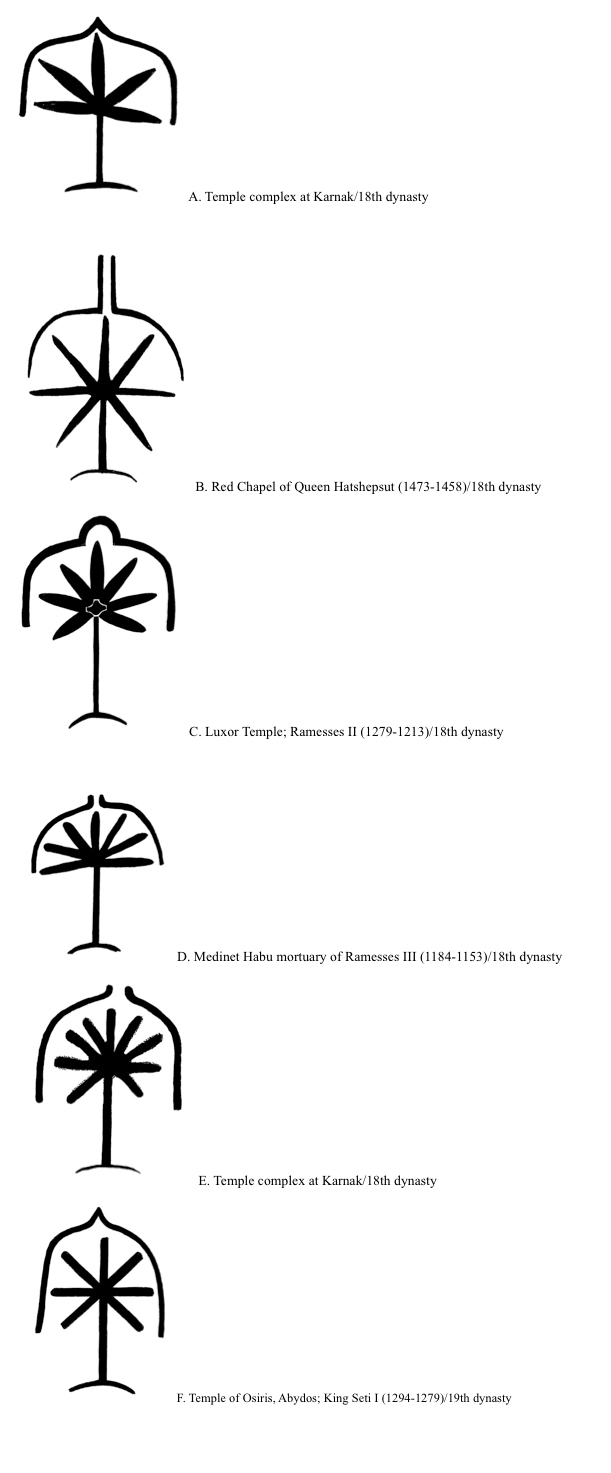
SECRET CROWN OF SESHAT IN PLAIN SIGHT

CROWN

NUG Magazin with article by Carl Hedberg on “Solving the mystery of what the ancient Egyptian goddess of wisdom was all about…”