On International Reggae and secularization of Rastafari 1972-1980

#rebelmusic #reggae #rasta
Ultimately, however, international reggae‘s appeal to international audiences may have had more to do with changes in the image of reggae artists, the packaging of the albums, and the sound of the music itself.

In his efforts to market the Wailers, for example, Blackwell first molded the Waiters‘ image into that of a rock-and-roll group. While reggae “groups” typically had consisted of a loose collection of singers and hired studio musicians, Blackwell promoted the Wailers as a stable, self-contained “band”—much like the Rolling Stones or Led Zeppelin.
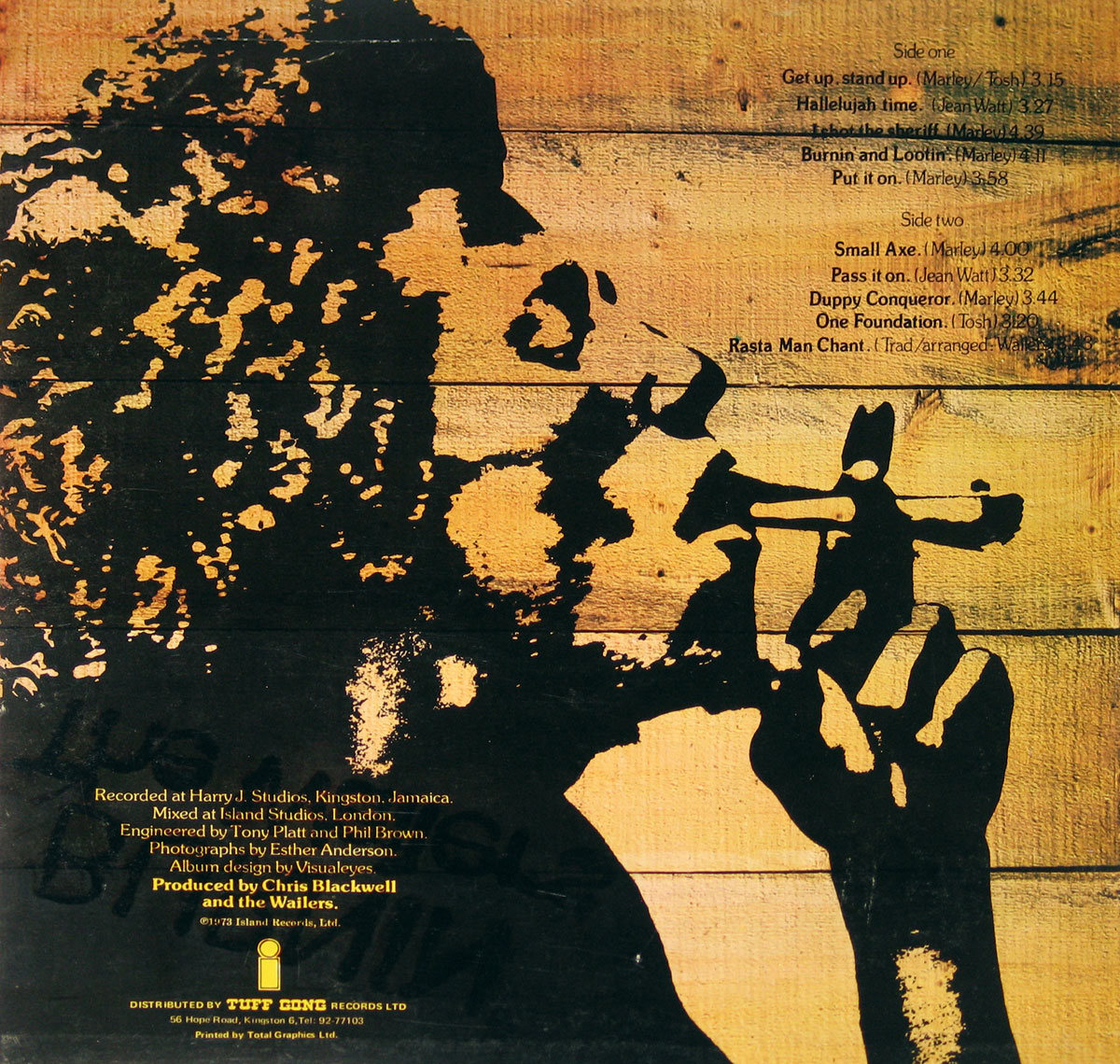
Second, Blackwell led a new trend among Jamaica’s record producers toward original, thematic, and full-length LP (long-play) albums, again following the lead of rock-and-roll groups. Previously Jamaica’s
record producers had distributed mostly singles or cheaply produced compilations of “greatest hits”.

Finally, those albums came packaged in glossy, well-produced jackets promoting the image of the rebellious, ganja-smoking Rastafarian. On the back cover of the Waiters‘ 1973 album Burnin‘, for example, Marley was pictured smoking a 12-inch spliff, or marijuana cigarette. On Peter Tosh‘s 1976 album, Legalize It, the singer was photographed crouched down in a ganja field. Reggae album covers also emphasized the Rastafarian’s symbol of black defiance, the dreadlocks, or displayed the Ethiopian colors of red, green, and gold. The cover of the Wailers‘ 1980 album Uprising, for example, featured a drawing of Bob Marley, along with the album’s title in red, and a background of green mountains
and a gold sun.

While most of the major instrumental innovations of international reggae were established during the early reggae period, international reggae was marked by a more sophisticated and polished studio sound. Most early reggae songs were recorded in primitive studios in Jamaica. International reggae, however, generally was recorded in state-of-the-art studios in the United States or Great Britain.

According to Jones, this helped to undermine “the common accusation made by rock fans that reggae was a music of ‘inferior’ quality”. In the first attempt to reverse this trend, Chris Blackwell took the Wailers‘ instrumental tracks for Catch a Fire, previously recorded in Jamaica, and remixed, edited, and mastered the tracks in a London studio.

Rock critics Ed Ward, Geoffrey Stokes, and Ken Tucker highlighted the dramatic change in reggae’s new sound: “Catch a Fire” was a “revolutionary example of reggae recording, far superior in its technology than most other reggae records”.

U.S. and British record producers also manipulated the instrumentation in reggae arrangements to create a lighter, “softerreggae. Some U.S. record producers would deemphasize reggae’s dominant instruments, the electric bass guitar and drums, and push the keyboard and electric guitar to the front of the mix. In 1980, Jamaican dub poet Linton Kwesi Johnson provided a clear rationale for the systematic manipulation of the reggae sound:
“[there was the] belief that the hard Jamaican sound, with the emphasis on the drum and the bass, would not be as accessible to the non-Jamaican listener as a lighter sounding production would be”.
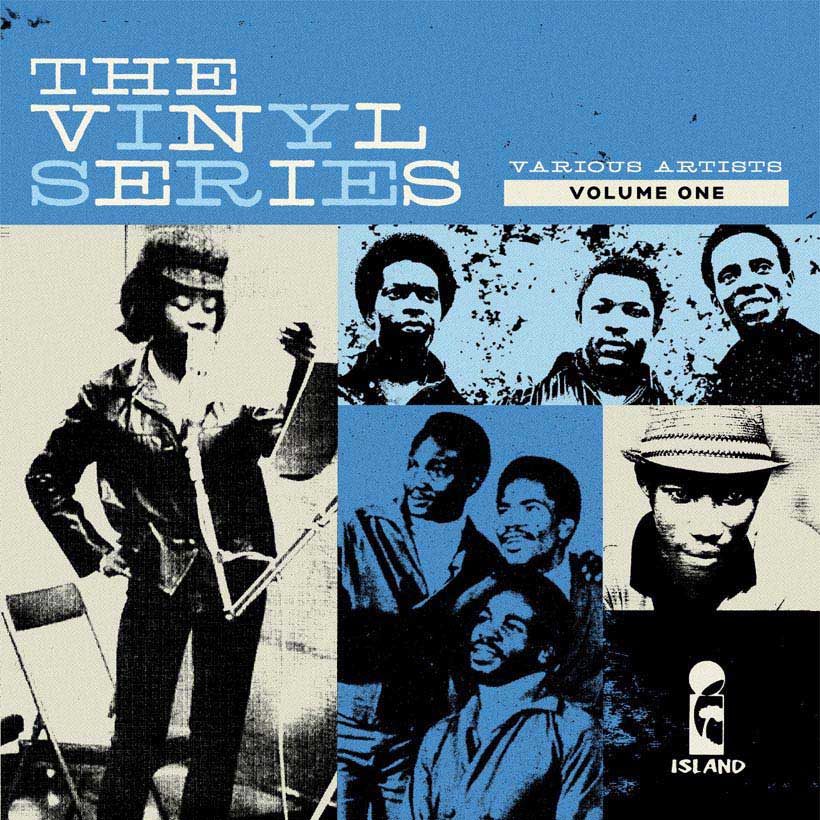
To appeal to international audiences, reggae musicians also incorporated familiar genres of American music into the reggae arrangement.

During the remixing of the WailersCatch a Fire, for example, Blackwell dubbed traditional rock-and-roll instruments, including rock guitar and synthesizer, over the reggae beat. During the recording of
the same album, a session guitarist, Wayne Perkins, also added guitar solos. Throughout their career, the Wailers dabbled in blues (“Talkin’ Blues” [Natty Dread]), funk (“Is This Love?” [Kaya]), and folk music
(“Redemption Song” [Uprising]). Similarly, Toots and the Maytals, in their 1973 Funky Kingston, fused R&B and reggae into the album’s title song.

In sum, the new international success of reggae music in the 1970s may have been more the result of marketing and changes in its sound than changes in its “message.” Reggae was still a “rebel music.” Growing up in some of Jamaica’s worst slums, reggae musicians still critiqued Jamaica’s neocolonial society. Reggae musicians also expressed concern about international affairs, specifically political problems on the African continent. While still sensitive to the problems at home, they also began
to identify themselves more as Africans than Jamaicans. In the final analysis, however, reggae’s international success probably was more the result of changes in its sound. Record producers improved and “softened” the reggae sound and incorporated new instruments, such as synthesizers and rock guitars, into the reggae arrangement.
Reggae musicians also borrowed freely from musical genres including rhythm and blues and funk. Yet whatever the explanation, reggae’s sudden status as an international musical sensation focused unprecedented attention on the Rastafarian movement and exacerbated tensions within the move-ment. Indeed, the music created whole new groups of supposed Rastafarians apparently attracted to the movement by little more than the image of the “Rastaman” and the music itself. These “pseudoRastafarians had little in common with traditional Rastafarian principles and beliefs.

Parts of Chapter Reggae Music in the 1970s: “Bubbling on the Top 100” from:

Stephen A. King (1998) International reggae, democratic socialism, and the secularization of the Rastafarian movement, 1972–1980, Popular Music and Society, 22:3, 39-60,
DOI: 10.1080/03007769808591713
On co-opting Reggae and Rastafari revolution

Jah Billah intro:
This text highlights tactics used by Babylon to regain social control over revolutionary social movements.
In escalating progression these appear as:

Evasion – ignoring
Counterpersuasion– ridicule and linguistic control
Coercion or Coercive persuasion – violence
Adjustment – co-opting the social movement
Capitulation – Babylon take over

Even if take just a quick look at first tactic “creating dead channels” we can witness how online media surrounds us with fake activist influencers who do the talk yet never remember to do the walk.

CIA, Guns, and Rasta: Inside the Making of Reggae’s Most Iconic Film

The Rhetoric of Social Control 

Responding to the agitation of a social movement, ‘‘establishments’’ tend to Resort first to ‘‘evasion,’’ which involves, in effect, pretending that the social movement ‘‘does not exist or that it is too insignificant to recognize’’.
Establishments can postpone action, appear constrained to grant protest goals, control or change the social or political agenda , lie and control information, deny protestors the physical means of protest, deny protestors access to the media, and create ‘‘dead-­‐end’’ channels of influence.
For example, during the 1960s, several poor, Black communities in Baltimore waged a war on poverty, challenging the dominant White majority who controlled the city’s political structure.
In order to thwart the demands of the protestors, Baltimore’s political establishment employed a standard evasion tactic, changing the political agenda. The protestors insisted that the city government must invest the necessary time and resources to address Baltimore’s impoverished areas. In response, Baltimore’s political establishment changed the political agenda to ‘‘improve the absolute well-­‐being of the city’s entire population, not to effect a redistribution of values in favor of the poverty-­‐stricken blacks’’.

The second strategy is called ‘‘counterpersuasion.’’
In counterpersuasion, governments and their surrogates seek to discredit movement leaders or to show their ideas are ‘‘ill-­‐advised and lack merit’’.
Counterpersuasion may be part of a larger rhetorical matrix called ‘‘administrative rhetoric,’’ or the establishment’s attempt to undermine a social movement’s ideas and influence.
A number of counterpersuasion tactics have been identified, including ridicule, discrediting protest leaders and organizations, appealing to unity by ‘‘crying anarchy’’, and linguistic control.
In a study on the Equal Rights Association, Martha Solomon ( 1978) argued that the STOP-­‐ERA political campaign employed the tactic of ridicule to paint ‘‘an unappealing picture of the feminists’ physical appearance and nature’’.
Portrayed in ‘‘devil’’ terms, ERA supporters were labeled ‘‘anti-­‐male,’’ ‘‘arrogant,’’ and ‘‘abortive.’’ In contrast, ERA opponents were characterized within the ideological framework of the ‘‘Positive Woman’’—physically attractive, intelligent, and emotionally fulfilled.

When milder strategies prove unsuccessful in counteracting the agitation of a social movement, establishments typically resort to a strategy of ‘‘coercion.’’
This strategy may remain largely rhetorical, what Stewart, Smith, and Denton refer to as ‘‘coercive persuasion’’. Simons ( 1972, 1976) coined the term ‘‘coercive persuasion’’ because he believed ‘‘elements of persuasion and inducement or persuasion and constraint are generally manifested in the same act’’.
For example, police officers combine physical and verbal intimidation to control deviance before a social disturbance breaks out.

If ‘‘coercion persuasion’’ fails, the conflict can escalate to more physical tactics, such as restrictive legislation, physically attacking demonstrators, firebombing homes, imprisonment, or even assassination.
Oberschall ( 1973) observed that during this conflictual stage ‘‘the authorities seek to destroy the organization of the opposition, arrest their leaders, and even set up stooges that allegedly speak for the population from which the protestors are drawn’’. In a comprehensive study of how riot commissions interpret and investigate riots, Platt ( 1971) reported that an estimated 34 people died and over 4,000 were arrested during the 1965 Watts riots. According to Platt, a jury later discovered that the Los Angeles Police Department and the National Guard were responsible for 23 of the 26 ‘‘justified’’ murders.

When all strategies have failed, an establishment may employ the ‘‘adjustment’’ strategy, which ‘‘involves making some concessions to a social movement while not accepting the movement’s demands or goals’’ .
Adjustment tactics can encompass ‘‘symbolic’’ concessions, such as Manley’s public praise of the Rastafarian movement, or establishments might sacrifice some of their own personnel if a ‘‘social movement focuses its agitation and hatred upon a single individual or unit’’.
Elites can use economic rewards to satisfy and stratify a protest group or establish committees to investigate issues.
If a social movement’s agitation becomes especially intense, the establishment might even incorporate movement leaders and sympathizers into the establishment by appointing them to low-­‐level decision-­‐ making positions.
Or the establishment might incorporate parts of the dissent ideology into the mainstream, entering into a loose confederation with the social movement.

Yet, cooperation with a dissent group ‘‘may lead to outright co-­‐optation of the cause’’ or a literal takeover of the movement by elements of the mainstream establishment. Gamson ( 1968) suggested that establishments use the co-­‐optation strategy when prior control strategies were unsuccessful.
Social movements that are co-­‐opted are often ‘‘subject to the rewards and punishments that the organization bestows’’. In fact, according to Gamson, ‘‘new rewards lie ahead if they show themselves to be amenable to some degree of control’’.

The final strategy, capitulation, occurs when the social movement’s ideas, policies, and personnel ‘‘replace those of the target institution’’.
In the case of the Rastafarian movement, the Jamaican government did not capitulate to the demands of the Rastafarian movement. Instead, the Jamaican government and its supporters co-­‐opted the cultural symbols of Rastafari and reggae music as authentic reflections of Jamaican society.


Text from:
The Co-optation of a ‘‘Revolution’’: Rastafari, Reggae, and the Rhetoric of Social Control
Author:
King, Stephen A. (1999).
Faculty Research and Creative Activity. 15.
http://thekeep.eiu.edu/commstudies_fac/15

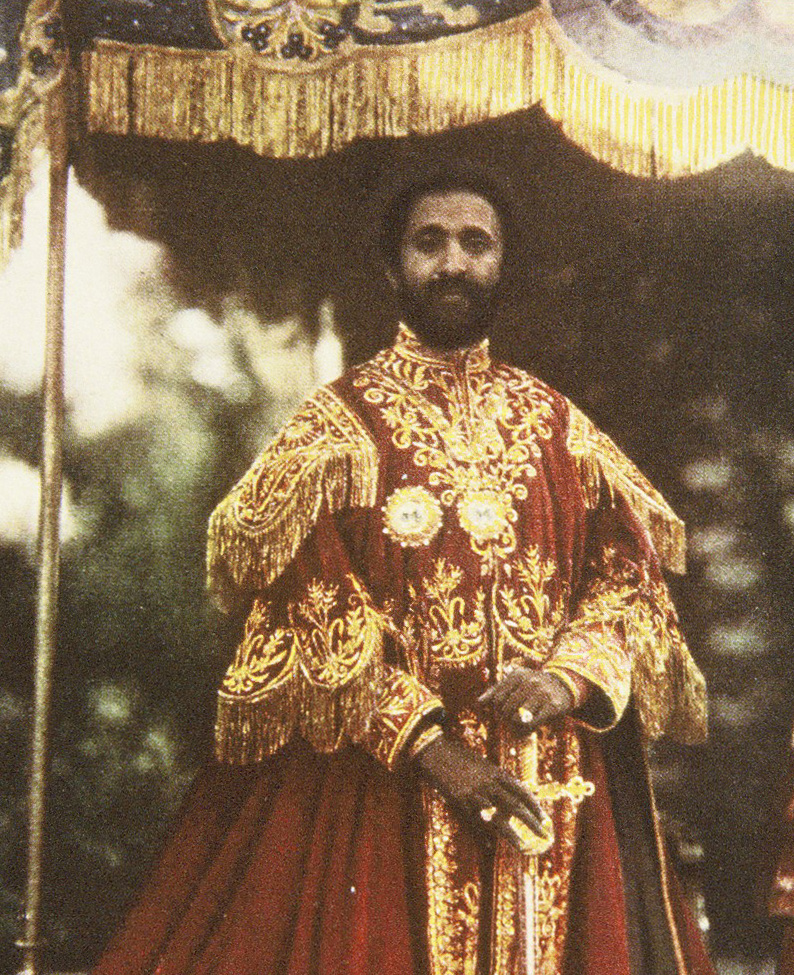
On Haile Selassie as God and King

“I know that the Jamaicans are here because of our king,” Daniel Wogu, an eighteen-year-old student and Shashemene inhabitant working toward acceptance in a medical program, told me. “They believe that he is sent from God to save them or make the black people free from slavery. They have their own history,” he continued. “As I have learned
from Ethiopian history, they say that our king went to their country to visit and there were some unexpected happenings. There was rainfall or something. They say then that this proves that Haile Selassie is not actually a man, but is God.”

Henock Mahari, an Ethiopian reggae musician born and raised in Addis Ababa, the city where he still lives and works, said something similar: “He was once in Jamaica and it hadn’t rained, and then it did rain. They accepted him as a God because of this miracle. They see him as a messiah and call Ethiopia their Promised Land and leave their home to come here and finish their life here.”

In a general discussion with my hundred-strong English language class at the Afrika Beza College, a female student told me that “Jamaican people live in Shashemene and they like Ethiopian people very much because Haile Selassie went to their town and at that time there is no rain. When Haile Selassie got there, there was rain. So, after that day, Jamaican people like Ethiopia very much.”

Shemelis Safa, a high school teacher in the town, had a similar explanation for why Rastafari move to Shashemene:
As I know, Haile Selassie went to Jamaica. It was very dry and they needed rain. Unfortunately, when this king arrived in Jamaica, the rain came. There started a superstition, a belief—“oh this is a good person,” they said. Their famous singer Bob Marley and other leaders told the people that the King is a very nice king and Ethiopia is very nice, so they associate the king with their religion. . . . Haile Selassie is from the Solomonic dynasty and they consider Haile Selassie God, so they respect him more than the people in Ethiopia.
We Ethiopians saw Haile Selassie as a king—a man who made many mistakes and did some good things.

Found in The Miracle Story, from Chapter:
Christianity and the King, Marriage and Marijuana.
Book Title: Visions of Zion: Ethiopians and Rastafari in the Search for the Promised Land
by Erin C. MacLeod. NYU Press. (2014)
Image source: African Kings and Queens and world Kings and Queens in forum Deshret at EgyptSearch Forums.

DERIVATION FROM A N K H

ANKH
But a most surprising Hebrew derivation from A N K H is the first-personal pronoun, I. It is in fact the A N K H itself unchanged except for the inconsequential insertion of two minor vowels o and i, making it ANOKHI. This is amazingly significant, since it reveals the identity of the innermost soul-being of man, the I ego, with the primal cosmic mind. That consciousness in man which enables him to think and say “I” is indeed a unit element of that same cosmic mind. In the I-consciousness of a creature the central creative mind energy of the universe is nucleated in unity. And as the ruler of all life in every domain, it is in that function and capacity the king of life! That power which knows things is verily creation’s king. And also then it must be the power that thinks. Gerald Massey, great scholar of ancient occult knowledge, connects in kindred significance think and thing, a thing being that which has been thought by some mind. The I, as the king of consciousness, both thinks and knows. The German has for king Koenig, the one who can, (which in German is koennen) and the one who knows what is best. And what has the Greek for king? Astonishingly anax, which is equivalent to the spelling anaks.

The Greek for messenger, one who ties the sender with the recipient of a message, is angelos, from which is our angel. And messenger itself has the ng in it. Where two lines meet we have an angle. A nook suggests something in the A N K H meaning. Perhaps hundreds more words might be traced from this venerable but most significant origin in the A N K H. And the words themselves help us reestablish the fundamental elements in the composition and structure of the great ancient knowledge so well called the Gnosis.

THE ESOTERIC STRUCTURE OF THE ALPHABET
by Alvin Boyd Kuhn

THE COURT MUSIC

CHEIK
CHEIK 2