
The Mystery System
This system was divided into two levels, which were exoteric and esoteric. The level, which was exoteric, was the general education that everyone in Kush, Kemet (Egypt), and Nubia were afforded. The level, which was esoteric, was the hidden mysteries, or a secret knowledge that led the initiate to higher state of consciousness. There education consisted of medicine, mathematics, geometry, music, land surveying, trade and commerce and other disciplines as well. These disciplines were applied to all areas of human endeavor. These two forms were found in seven degrees.
Pastophoros is the degree, which teaches basic aspects of medicine and includes all known and unknown sciences. It deals with one physical nature. This degree has influenced the Entered Apprentice because it is said that the
left side of the human body is the weakest and it was therefore that the entered apprentice was in the weakest form.
The initiate advances to the degree of Neocoros, which teaches the structural energy of shapes particularly in ‘geometry’. For example, a milk carton has a pyramid shape and possesses the ability to slow down the organic degradation of organic materials. The tekenu, or obelisk represents the male and female
principles, which continues mankind. It also expresses divine char-acteristics such as the square, which is the symbol that is suspended around the neck of Ptah, and is the throne of Ausar. The circle is the representation of the sun, which is the life giver and depicts Ra in this from. In all, geometry represents continuity and generation of life.
The initiate then advances to the next degree known as Melanophoros and it teaches about the energy forces between life and death states. This degree is directed to the indigenous people because of their high melanin con-tent.
Melanin is a word derived from the Greek word melanos, which means ‘black’. Melanin is a carbon base molecule and carbon is the key atom to life, which is black itself.
It represents universal and unlimited power. Melanin can convert energy into other forms for proper use. It is divine law that everything that exists comes from out of the blackness of the cosmos. From the blackness of the water comes life; out of the blackness of the earth comes forth the plants of the world, which in turn gives other life sustenance; from the blackness of a woman’s womb comes human life and from the blackness of black woman’s womb comes the human race. This degree involves the theology of life, death, resur-rection and immortality through the Ausirian Drama, which deals with Ausar’s or Osiris’ (which he was known as ‘Lord of the Perfect Black’) life, death, resurrection and immortality. This degree is where the Hiram Legend is extracted.
The next degree is Kistophorus, which involves understand-ing the inherent laws of plants, music, colors, magnets, metals and crystals and other elements of the cosmos. It is in this degree, Pythagoras during his learning in Kemet, understood the ‘Music of the Spheres’, which he in turned implemented among his initiates into his cult and the Fellow craft is taught about the inherent laws of the elements as well.
Balahate is the degree, which teaches about the interactions of alchemic laws and nature. This degree is not so much based on the physical plane, but on a metaphysical where like in Free-masonry, working tools or sub-stances becomes allegory and takes on a spiritual use.
The sixth degree is Astronomos, which teaches manipula-tion of cosmic forces.
The seventh and last degree is Propheta, which teaches the esoteric mysteries and secret theology within the priesthood (brotherhood), which lead the initiate of this degree to deification. The duration is 40 years or more, which begins at the age of seven and completed at the age of forty-seven.
Author: Jah Billah
JAH BILLAH creates anachronical synchro-mystical DUB outta riddims built by various artists from all over the world. Linking up within independent network of riddim makers, producers and fellow dubbers into global organic sum of musical efforts. So far Jah Billah dubbed reggae music from Bosnia & Herzegovina, China, Croatia, Czech Republic, Denmark, Finland, France, Germany, Jamaica, Mexico, Netherlands, New Zealand, Poland, Romania, Russia, Spain, Switzerland, Sweden, Trinidad, UK, USA, Vietnam... and all around so awarded by the people the title of honor „AMBASSADOR OF DUB GALACTIC NATIONS“ .
TONY DUBSHOT ON MYSTERIES OF DUBB
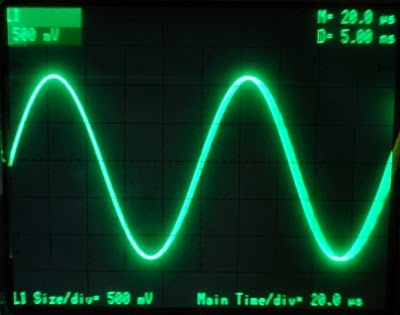
Dub scientist Tony Dubshot reveals that black holes are the biggest woofers, contemplates the difference between sine wave and white noise, instructs in creation of DIY deepest bass possible and more in:
Mysteries of Dubb ~ How low can you go?
CELESTIAL, PLANETARY AND ASTROLOGICAL CORRESPONDENCES – NOTES & TEMPOS
I. Celestial, Planetary and Astrological correspondences.
Planetary Notes:
C – Mars
D – Sol
E – Mercury
F# – Venus
G# – Moon
A – Saturn
A# – Jupiter
Astrological Notes:
C – Aries
C# – Taurus
D – Gemini
D# – Cancer
E – Leo
F – Virgo
F# – Libra
G – Scorpio
G# – Sagittarius
A – Capricorn
A# – Aquarius
B – Pisces
Planetary Tempos:
Saturn 69.3 BPM
Moon 98.6 BPM
Mercury 66.2 BPM
Venus 103.7 BPM
Sun 118.3 BPM
Mars 67.8 BPM
Jupiter 86.1 BPM
Nepturne 99.1 BPM
Pluto 65.7 BPM
Uranus 97.2 BPM
From Occult Music Correspondence Tables by Aleph9 Waveform Research Journal
JARON LANIER ON DIGITAL TECHNOLOGY
I’m quite concerned that in the future someone might not know what author they’re reading. You see that with music. You would think in the information age it would be the easiest thing to know what you’re listening to. That you could look up instantly the music upon hearing it so you know what you’re listening to, but in truth it’s hard to get to those services.
I was in a cafe this morning where I heard some stuff I was interested in, and nobody could figure out. It was Spotify or one of these … so they knew what stream they were getting, but they didn’t know what music it was. Then it changed to other music, and they didn’t know what that was. And I tried to use one of the services that determines what music you’re listening to, but it was a noisy place and that didn’t work. So what’s supposed to be an open information system serves to obscure the source of the musician. It serves as a closed information system. It actually loses the information.
From Jaron Lanier: The Internet destroyed the middle class
by Scott Timberg, 2012.
DR. DAS ON POLITICS OF DUB BASS
Describe the politics you feel are inherent in dub bass.
It relates to the general attitude which states that bassists are just there to do a job and hold down the rhythm, whereas vocalists and guitarists are the ones responsible for serious expression. To me, the bass has always been just as emotive as any other instrument. Dub music proves that’s so because it represents an inversion of clichéd perspectives about bass. With dub, the bass line is the hook of the song and the guitar is often there backing it up. The bass line also offers a low frequency melody that carries the key emotional content. The challenge in being a dub bassist though is you’ve got to do all of that using as few notes as possible. However, your brief is the same as it is for any other instrument—ensuring how you feel about the world is reflected back into your playing.
From Dr. Das – The politics of dub bass
by Anil Prasad 2007.
NOTE FREQUENCIES & VISIBLE LIGHT SPECTRUM CORRESPONDENCES
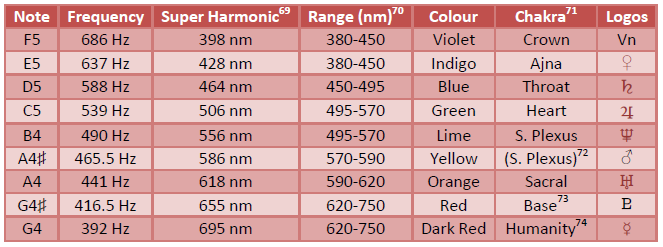
From Esoteric Harmonics – Tuning to the Occult Scale of Sound by Patrick Mulcahy 2010.
Z’EV ON VIBRATION
VIBRATION: THE IMPACTING OF ONE RHYTHM OFF ONE PLANE UPON THE
SUBSTANCE OF ANOTHER.
That is, the gas molecules [air] which the pressure zone vibrates, adopt its density and rhythm.
The atmosphere within the sound barrier is a meta-pressure zone composed of the infinite variety of these energies. Even more metaphorically: pressure zones are currents in the sea of sound within the shores of the sound barrier. Our sound barrier is formed by energies vibrating faster than 76o m.p.h.
How the qualities of energies of this velocity and vibration rate are heard entails a three-stage process. First, by a mechanical process in the middle ear, when the
exterior energy [pressure zone] vibrates, successively, the ear-drum, hammer, anvil, and stirrup transferring a re-proportioned energy to the inner ear. This begins a hydro-electrical process. The fluids of the cochlea vibrate, which in turn vibrate/fire the neurons along the basilar and tectorial membranes of the cochlea.
As neural impulses in the voltage of the central nervous system, the exterior energy has been transformed back into the realm of electricity [physical light].
The first place these neural impulses go is the memory, where they are distinguished, say, from the taste in your mouth right now, and from there to the cognitive center of awareness.
All sensory impulse first arrives at memory.
from
Rhythmajik – Practical Uses of Number, Rhythm and Sound
1992. by Z’EV


 OUT OF MANY COME DUB AND OUT OF DUB COME ONE